Rabbit Diseases and
Health Hub Page
Rabbit
Diseases: Major symptoms of the more common diseases affecting rabbits, like snuffles
and enteritis.
We'll help you get to know some of the major symptoms of the major rabbit illnesses, and what you can do for these health challenges, including some effective home remedies.
Rabbit Health: 3 rabbit husbandry practices that will help to optimize rabbit health and minimize the onset of disease.
To get to the true cause of your rabbit's illness, Always check with a vet right away.
Since we're not vets, see the disclaimers at the bottom of this page.
The Merck Veterinary Manual has a good amount of rabbit health care information.
 (Pictured: Keep Your Rabbits Healthy, our ebook on keeping bunny happy and healthy. |
To help your rabbit live his best life, check out our ebook: Two of the most important questions a rabbit owner has: Keep Your Rabbits Healthy is all about how to keep your rabbit free from injury and disease, and what to do in case something happens. It has lots of pictures so you can compare your rabbit, and know exactly what you're seeing. This has everything on how to take care of bunny from teeth to feet. Summer sale! All of our ebooks are ON SALE, 30% off! |
Rabbit Diseases
This page contains a fairly long list of nearly all the rabbit diseases that could possibly befall your rabbit or your rabbitry, plus links to pages of additional information about conditions impacting your rabbit's health.
You might not ever need to worry about the vast majority of these rabbit diseases, however pasteurellosis and some forms of diarrhea are fairly common banes amongst rabbits. I've listed them first.
PASTEURELLA MULTOCIDA (Snuffles)
- Does your rabbit tend to sneeze repeatedly, in long jags of sneezing or snuffling?
- Do you frequently see clear mucus or thick white or yellow snot in your rabbit's nose?
With regrets, these two symptoms together are diagnostic for Pasteurellosis, and occasionally for Bordetellosis (see below). Pasteurellosis is frequently incurable, very contagious respiratory disease. Snuffles is the common term, which describes the sounds made by rabbits that have mucus-filled nasal airways. The term Pasteurellosis is a reference to the causative bacteria: Pasteurella multocida.
Pasteurellosis can quickly degenerate into pneumonia and death. It is also the guilty agent in a variety of other serious infections in other parts of a rabbit's body other than its respiratory system.
Do not use a rabbit with Snuffles as a breeding animal.
Learn more about Snuffles here
There is a glimmer of hope for curing Pasteurellosis if...
- the infection has not yet become established in areas of low blood flow such as the sinuses
- the pasteurella bacteria species is not highly pathogenic.
Is your rabbit sneezing due to Pasteurella bacteria or other simpler causes? Click here.
If antibiotic treatment is to be successful, it should be instituted promptly upon development of symptoms. Unfortunately, many rabbits that come down with Pasteurellosis cannot shake the infection, despite treatment.
How rabbit breeders can gain control of pasteurellosis (snuffles) in their herds - Utilize this breeding and culling program which can eradicate the disease in your rabbitry within one to three years, and fix health in your rabbits' genetic code.
Great News for Pet Rabbit Owners:
The BunnyVac is a Pasteurella multocida vaccine for rabbits in the USA. It is licensed by the USDA for use in healthy rabbits to prevent snuffles. But the off-label use in sick rabbits has been reported to reduce or eliminate symptoms of respiratory illness in some sick rabbits. It is not a panacea, however.
See Rabbit Vaccine Immunity for more on how the BunnyVac works.
7 reasons why a show rabbit breeder should think twice about vaccinating against P. multocida
BORDETELLA
in Rabbits - Bordetella bronchiseptica infections in
rabbits can look and act a bit like Snuffles, but how to tell the
difference? Learn to recognize the symptoms and how, or if, to treat.
These rabbit diseases can cause severe watery or mucoid diarrhea of varying severity. Some can be fatal within 12-48 hours:
- Enterotoxemia: A sudden and acute diarrhea often in 4-8 week old rabbits resulting in death within 12-24 hours
- Tyzzer’s Disease: Looks just like enterotoxemia, including rapid death, however it is caused by a different bacteria.
- Coccidiosis: Can cause severe diarrhea, but the liver form of the disease is much more concerning (also causes diarrhea)
- Mucoid Enteritis: Causes are uncertain, but it is frequently accompanied by a bowel blockage.
- Epizootic Rabbit Enteropathy: Highly contagious rabbit diarrhea affecting many in the herd at the same time.
- Bunny Enterotoxemia: If you're alert it'll stay mild; if not...
BE PREPARED:
Dysbiosis - a disruption of the normal healthy bacteria in the rabbit gut - can occur suddenly and without apparent cause. The result could be a mild bunny diarrhea, a potentially fatal enterotoxemia, or something in between. Having a tube or two of Benebac on hand could save a bunny-life or even the life of a stricken adult rabbit by re-supplying healthy gut bacteria and normalizing the action of the intestines.
Add Benebac to your arsenal of remedies for rabbit diarrhea.
(More)
Infectious Rabbit Diseases
Abscesses
Suspect an abscess if your rabbit has a soft round lump under the jaw line or nearly anywhere on the body. A pus-filled abscess is due most frequently to either
pasteurella or staphylococcus infections just under the skin. Click
here for info on abscess treatment in rabbits.
Rabbit Hemorrhagic Disease (RHD) is a devastating viral disease that can wipe out your entire herd in a matter of days. This is one rabbit disease every United States or Canadian rabbit breeder should know about and protect against.
RVHD and RVHD2 are killing rabbits in the UK and Europe. Since these two strains of Rabbit Hemorrhagic Fever are endemic there, they handle outbreaks differently, and they have developed vaccines for both strains of viral rabbit diseases.
RVHD in BC: Info on the ongoing 2018 outbreak of RVHD2 in British Columbia.
Myxomatosis
This is a very nasty viral rabbit disease carried without symptoms by wild rabbits. The disease is transmitted by mosquitoes, and is fatal. Myxomatosis is common in Europe. In the United States it is present in California and Oregon.
Myxy comes in two forms. In the rapidly killing form, all you see is a dead rabbit. But here are some clues you might see if you're watching:
- Slight redness of the eyelids
- Rabbit is limp or lethargic
- Rabbit has no appetite, and eats very little
- Rabbit's temperature is elevated to as much as 106 degrees F (normal being 101 - 102 F)
The next thing you know, the rabbit is dead.
There's a chronic form of myxy, where the face, lips and eyelids get huge lumpy swellings, and sometimes the ears as well. If, at the same time, the rabbit's vent (female) or scrotum (male) swells, you'll know it's myxomatosis.
See photos of stricken rabbits here, along with technical (veterinary) info on Myxy.
The worst time for the spread of myxy is mosquito season - late summer and early autumn.
There is no cure for this disease and no vaccine in the United States. Europe has a vaccine. Consult your local rabbit clubs for vaccination schedules.
What to do (USA):
Immediately destroy sick rabbits, and burn or bury their carcasses. The recommendation of Drs. Cheeke and Patton in Rabbit Production is: Whenever a rabbit goes off its feed or appears abnormal, and if the rectal temperature is elevated above 103.5 degrees F, kill the rabbit and bury the carcass. In their opinion, the disease is so deadly, it is better to mistakenly kill a rabbit that is not infected with myxy, than to let one live that does.
In areas where myxy is endemic, it is a good idea to control the presence of flying insects in your rabbit barn. This is a nasty viral disease that ranks right up there with the worst rabbit diseases.
Rabbit syphilis is another name for 'vent disease.' This highly infectious disease results in crusty, inflamed tender sores around the genitals. The sores can spread to the face and nose with grooming and coprophagy.
An infected animal will resist breeding due to the discomfort. But since it is contagious, one infected animal that is infectious but not yet showing symptoms can spread the disease to many other animals.
Check your breeding animals frequently, and be very careful with studding your bucks. Some recommend dedicating a buck to stud service and not using that buck in your own herd.
Rabbit syphilis is easily cured with penicillin.
Get the whole scoop on Rabbit Syphilis here
The following serious infections can threaten or take the life of lactating does:
Mastitis: Infection of one or more mammary (milk) glands, also called 'caked udder.' If the nursing doe stops eating, check her milk glands. Additionally, she will run a fever of, say, 104 degrees F or more.
The doe needs immediate antibiotics to prevent a full-blown abscess and hardening of the milk gland.
Young Doe Syndrome: The doe suddenly dies, 4-10 days after kindling a perfectly fine litter. The doe may go off her feed. You might also notice a touch of rabbit diarrhea. The cause of Young Doe Syndrome is enterotoxemia, but a staph infection of a milk gland can also cause sudden death in the lactating doe.
Maintaining clean cages can help prevent mammary gland infection ("caked udder," "blue udder,") and giving hay on a daily basis can help prevent enterotoxemia.
Condition Enhancers: BOSS, Whole Oats
Rabbit illnesses caused by
Parasite Infestations
These rabbit diseases or conditions are the result of parasites:
- Ear Mites
- Fur Mites
- Encephalitozoon cuniculi, also known as EC, or Nosema
- Pinworms
- Raccoon Roundworm (Baylisascaris procyonis)
- Ringworm
- Tapeworms: If you have dogs, you should know about the possibility of tapeworm cysts in your rabbits.
Non-Infectious
Rabbit Health Care Concerns
Our Rabbit Health Care page gives tips and information on dealing with other non-infectious challenges to your rabbit's health:
- Broken Back
- Cannibalism
- Dystocia
- Hairballs
- Heat prostration
- Hutch Burn
- Obese Rabbits
- Red Urine
- Sore hocks, calluses on rabbit feet
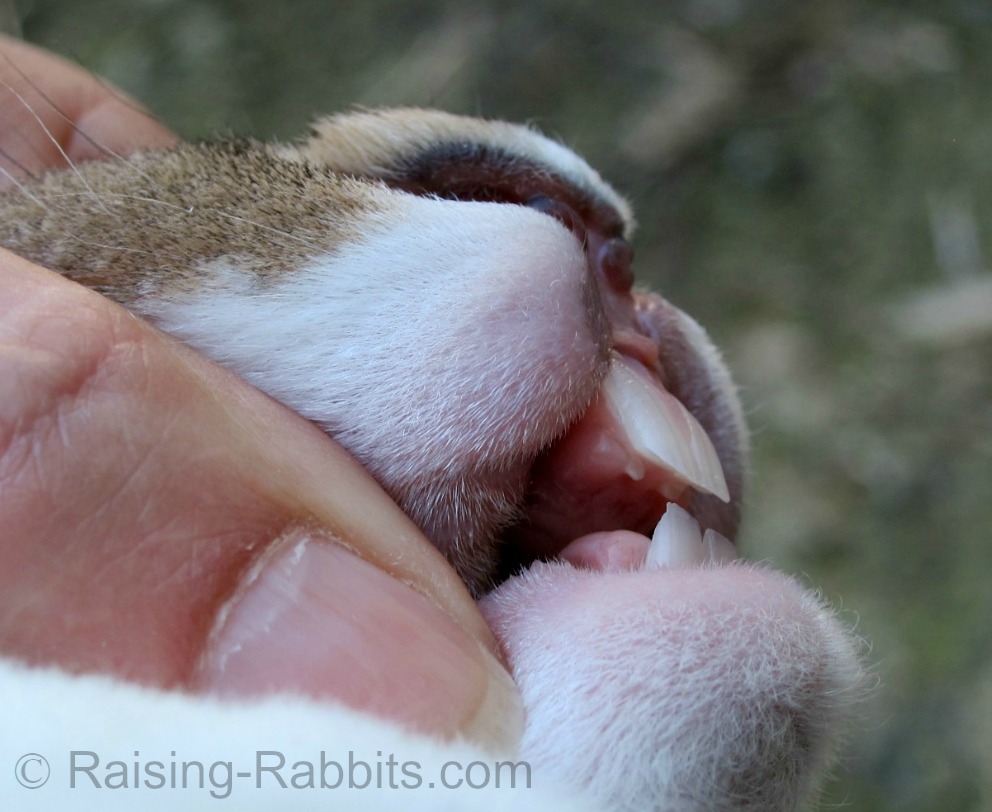
Learn what you can do, if anything, about malocclusion, which is when the rabbit's teeth don't wear down correctly due to an incorrect alignment of the teeth, resulting in the teeth growing excessively long. Other terms for malocclusion are buck teeth and wolf teeth.
Pictured: All 6 of the rabbit's front teeth are perfectly aligned
All the above is a TON of information! It's all yours (and then some) in our health and diseases e-book: Keep Your Rabbits Healthy...
Keep Your Rabbits Healthy
Two of the most important questions a rabbit owner has:
- Is my rabbit healthy?
- How do I keep it healthy and happy?
Keep Your Rabbits Healthy is a very easy guide on making sure your rabbit lives his best life. Illness and injury can be quite scary, especially if you don't know what to look for or what to do to help your rabbit. Keep Your Rabbits Healthy is a straightforward book for real people, with lots of pictures, so you know what you're seeing. Keep Your Rabbits Healthy has preventative care to ensure your rabbit's well being, and tells you what to do and what to look for when your rabbits need your help.
Summer Sale:
30% Discount on All E-Books!!!
Buy Now for only $12.99 $8.99
To find out about all of our great books, check out World of Raising Rabbits.
As always, your purchase is 100% risk free. See our Double Value Guarantee below.

Disclaimers
While we have hands-on experience with the most common of rabbit diseases, Raising-Rabbits.com has no actual veterinary expertise. We do know that a normal temperature for a rabbit is 101 - 102 degrees Fahrenheit.
First Disclaimer:
Our desire is to communicate what we’ve learned through hard-earned experience over the last 30 years. Some of it will be very helpful to you. But if your rabbit is sick and you’re looking for guidance, we can at best only show you the big picture of what some rabbit diseases typically look like. There’s not a chance we can help you make a definitive diagnosis. Always consult a professional veterinarian, especially one that specializes in rabbits and small mammals.
About rabbit vets: They’re not as easy to find as you might think! So you’d be well served to locate a vet experienced in rabbit diseases before you have any need of him. Because when you need one, you may very well need him right away.
Second Disclaimer:
In the United States, a pet rabbit can cost as little as $10, and as much as $30. The majority of show-quality purebred rabbits will set you back at most up to $100. We think that for the price of a veterinary visit (and toss in any drugs you might be advised to purchase), you can, and maybe you should in some circumstances, simply replace your rabbit.
This is absolutely no consolation to the owner of a well-beloved pet bunny.
Begging your pardon, we know that in the case of a few, very
serious and contagious rabbit diseases, the sick rabbit should not be allowed
to live. For the rest, however, we
sincerely hope you will be able to work with your vet to find a way to make your
pet rabbit better.
Double-Value Guarantee
Our policy is to always OVER-deliver
on value,
which is why your purchase is fully covered by our
Double-Value
Guarantee.
Go ahead - take any of our e-books for a test drive. Peruse our detailed informational and educational e-books. Examine our plans for building rabbit cages, runs, or metal or PVC hutch frames. Check out the Rabbit Husbandry info e-books.
If you aren't completely satisfied that your e-book purchase is worth at least double, triple or even quadruple the price you paid, just drop us a note within 45 days, and we'll refund you the entire cost. That's our Double-Value Guarantee.
Note: When you purchase your
e-books, they will be in PDF format, so you can download them to any device that
supports PDF format. We advise making a back-up copy to a drive or cloud
account. If the books are lost, you can also purchase another copy from Raising-Rabbits.
Add your Comments or
Share your Experiences!
Your comments or experiences can help others who read them. So, comment away, and if you have pictures, you can post up to four of them. Pictures are always helpful.
(Have questions? Perhaps your question was already asked, and answered, below. If not, Karen has answered hundreds of your questions in her book: Rabbit Raising Problem Solver, covering every aspect of pet rabbit and livestock rabbit care as well as rabbit health and disease. We recommend it!)
Comments from Other Visitors...
Click below to see additional posts that other visitors have made to this page...
Bunny moves head slowly side to side 
Since I got her at 8 weeks my holland lop bunny does this, when sitting still.
She slowly moves her head from side to side, looks almost neurological, …
Something is wrong with my bunny!
Hello there people! My name is Mandy and my bunny's name is Elvis. He used to be really active. Jumping around every time I was near at his cage. I had …
White foam from rabbit's anus
I have a 7 year old buck that was neutered 3 years ago. He has begun passing white foam and I can hear gurgling from the bowel when I handle him.
Over …
Extremely Foul Smell
I sold an 8 week old mini rex buck to a family and received a call the next day saying there is a "run you out of the house" odor coming from him. He appears …
Mysterious death of rabbit
I have 3 rabbits put in a cage. The cage was big enough for the 3 of them. This afternoon I noticed that 1 rabbit was very weak. He seems like he has no …
My rabbit's neck
My rabbit's neck hairs are getting lost and he sniffs and coughs very badly and he put his 2 hands when he sniffs I am scared please tell guys what to …
Wild Rabbit Skin Nodule?
Found a next of wild rabbits late last week...or what was left of them - a neighbor's cat was in our bushes by the nest one morning and late the next day …
Mysterious bunny death--Wobbling side to side and Seizure
I had a 5 year old male Mini Rex that passed a few weeks ago, and I'm still wondering what it could possibly have been that killed him. Here's what happened: …
Reaction to the Myxomatosis vaccine?
My lovely, healthy Rex rabbit was vaccinated July 2014. In Oct 2014, she developed bad conjunctivitis which was treated by the vet and improved but 10 …
Rabbit running into walls
I have a 3 year old Mini Rex spayed female. Two days ago she was acting normal, running around eating and drinking. Yesterday I came in and found her moving …
9 year old mini dutch rabbit won't eat
I have a nine year old mini dutch, male. The last few days he would eat only lettuce, apple bits and small pieces of banana. He normally loves his pellets …
Sudden death - what was the actual cause?
I recently lost my very loved giant Flemish/Norwegian mix rabbit of 2 plus years. I got a new kitten a couple of weeks ago to become friends with my rabbit. …
4 month old New Zealand rabbit dead overnight
I fed her the night before and in the morning I checked her and she was dead. She looked like she was a bit blue around her mouth and her ears also looked …
Strange bald areas with defined edges on baby rabbits
Our baby rabbits around one month old are all developing bald spots on their bodies. The spots are spreading as one baby's spot started a couple centimeters …
Wart on Nose
My dwarf rabbit (less than a year old) has a growth coming out of the middle of his nose (like a horn). It looks like what an old potato gets on it (eye). …
Very sick 6 week old Holland Lop bunny
My holland lop had 7 beautiful kits and they have all been super healthy this whole time, momma was good. They have rabbit pellets timothy hay and water …
Newborn Bunny with light green poo
I raise meat rabbits and a first time mom did not care for her babies and I moved them with another mom who was also nursing. Two died and the others seemed …
My rabbit was family he just died I am so sad
My rabbit Danny was a dutch bunny he lived inside in his hutch plus he loved to go outside and bounce round the back yard. He was going to be a year old …
3 week old rabbit kits dying...help!
Please help. Within 2 days, we have found 2 of our seemingly healthy kits dead. They are 3 weeks old. All have been visibly healthy, running around, …
Rabbits with Seizures?
I just started raising rabbits 8 months ago. I have meat rabbits and Mini Rex. I spend an hour every morning and evening with my guys, plus check 2 to …
I'm worried about my buck with a red raw butt
My rabbit has been scratching at his butt
a lot and now its red and raw! Should I worry?
What should I do to make it stop?
** **
That sounds …
Sore on side of nose
I have a 16 week old rabbit. 2 days ago I noticed a sore on the side of his nose. I have looked endlessly on the internet to see what it might be, I have …
5 month old Netherland Dwarf went blind and may be ill?
I adopted a <4 month old Netherland Dwarf and when I got him he was in perfect health. He used to run around, jump up on the couch, veg out on the floor, …
Rabbit won't move legs and when picked up urinates
My female bunny has suddenly developed a very disturbing condition. When I came home I found her in her box .. when she saw me she came out but she wasn't …
Help! my rabbit is always sneezing!
My rabbit is constantly sneezing and every now and then a wad of thick white snot will come out. I'm starting to get a little worried. He is a little over …
Sick Rabbit
My 8 week old pet rabbit is listless, won't eat, won't drink, is poohing normal. I have taken him to vet who has given vitamin and glucose injections however …
Help...2 dead lionheads and sick owner
My daughter's bunny stopped eating and drinking for a couple of days and despite our best efforts to keep him hydrated with a dropper he passed away. There …
Whitish Yellowish Urine
My 10 rabbits are having a whitish yellowish urine for the last month! Does anyone know what this is or what to do about it? Thanks, Willie
* * …
Myxomatosis?
I have been looking after a friends three rabbits. One of them has developed a small bald patch (around 1/2 inch) on the side of her face. Next day there …
Help!!!
my rabbit out of no where started to make this weird like puking noise. He is drooling and I think there is snot coming out of his nose. please tell me …
My rabbit won't move!
My rabbit won't move and will just stay in the same place for hours!! he won't eat on his own, only when I hand feed him. When I put him down he just flops …
Dying Dutch Bunnies
Help!!!! I have a litter of dutch babies around 7 weeks old and over the last three days have found 2 on separate days lying on their sides heads arched …
My rabbits coat has turned yellow
Does anyone know why their fur turned yellow?
What color was the coat to start with?
I'm pretty sure the reason is sunlight, which 'rusts' the …
"Goopy" Eyes
We recently purchased a mini lop for my son. Several days after bringing her home we noticed one eye had some "goop" around it. It is not colored as …
My 1-yr-old rabbit has ear canker
My 1-year-old rabbit, Nima, has ear canker. I looked it up and many suggestions are that I apply olive oil to the ear and get the crust out with a Q-tip. …
5 year old lop ear rabbit is sick
My lop ear rabbit "Rodger" is having some problems. In the past few days he started with a very bad smell now he keeps tilting his head to one side, tear …
Rabbit Tongue Cancer
Hello! I bought my 2.5 yr old Holland Lop a month and a half ago from a breeder. Our vet had recommended the molar teeth grinding surgery recently, and …
Broken Back
My Rabbit may have broken his back, he is only 6 years old and he had has a bit of a wee problem. The vets haven't solved it yet but it had been very smelly …
Rabbit balance seems to be off
Our rabbit is less than a year old and is eating and drinking normally. What happens is he just flops over on his left side. We take him out of his cage …
Neurological Disease in my rabbit? Not rated yet
Hello everyone, I need some help with my 2 year old rabbit. About 8 months ago it started falling over strangely. At first we thought it was just clumsy, …
Red muzzle on kit Not rated yet
I am not a rabbit breeder but I seem to be in a streak of my buck Houdini has started a chain of pregnancies within my does since he came to me from my …
Sudden bleeding death of a rabbit Not rated yet
My rabbit died. I don't know what happened.
One hour ago after my rabbit had her monthly bath she collapsed suddenly, her feet were bright red and …
Something Is Wrong With My Bunny Dusty Not rated yet
Just gonna jump into it -- last night I was giving Dusty my bunny an apple slice treat.
He loves them he was so excited to get it.
He ate it and …
Bunny in pain Not rated yet
Came home to my bun scooching across floor and and then a few seconds later hunched in a ball.
Then she would repeat. She wouldn't eat or drink. I …
Vet called it Lop Ear Not rated yet
I had a female rabbit for about twelve years.
When she was about 10 her head went on one side and her ear lopped on the ground.
I took her to the …
Rabbits stop moving,
and then die Not rated yet
We have rabbits at home for 4H projects and so far have lost 3.
There are no real symptoms, they are fine and then the next day they really do not …
Swelling in Baby Rabbit's
Neck Wound
Not rated yet
Newborn baby rabbit (5 days old) was drinking mum's milk and the mum didn't like it so she kicked the baby and it went up in the air (30 cm) and dropped. …
Mum rabbit looks clenched, skinny and loose poos Not rated yet
I have a rabbit which I've taken to the vets a good few times and every time I've taken her she ends up being fine again. I get her home and after a …
Lactating Doe with Snuffles? Not rated yet
My bunny gave birth to 6 kits on 11/21/13. She has been healthy until 11/27/13. I notice she has been sneezing a lot, and after the next day, her nose …
Young Rabbit Stomachache Not rated yet
All my young rabbits 2-6 weeks or more they just never passing solid waste except urine and their stomach became bigger despite the appetite still good …
Diarrhea in doe,sudden convulsion, then death. Not rated yet
Symptoms: Doe was seen while doing morning feedings at 10:30am, everything seemingly in order (we are constantly in and out of our bunny room, and still …
Dutch Rabbit seems sad/watery eye? Not rated yet
I have a dutch rabbit called Benji, he's always been so happy and has the run of the whole garden except when he's back in his cage at night time.
…
Malocclusion Rabbit Not rated yet
I recently went and bought a beautiful Lionhead doe from a breeder. While there, she offered to give me a buck for free. She explained how he has malocclusion, …
My rabbit flops to one side Not rated yet
Hi I was wanting to know if someone could possibly tell me what's wrong with my rabbit. She was fine yesterday - she was playing, eating, and drinking …
Blind in one eye? Not rated yet
I got a Holland Lop bunny about 4 months ago and she had a tiny black spot on her eyeball where her normal color blue eye was. Well I noticed about a month …
Should I be worried about crusty rabbit eyes?? Not rated yet
I bought a 2 month old lionhead rabbit from a little bunny petting zoo that was at a pumpkin patch. She is so adoration and seems to be very sweet and …
Drug Withdrawal Time Not rated yet
Is it safe to send a rabbit to market, that had been treated for snuffles? He is about 15 weeks old, was treated by the vet, is back to good health. It's …
4 of 5 Baby rabbits sold to pet store died Not rated yet
On September 14 I sold 5 6 week old rabbits 4 Lionheads and 1 Netherland Dwarf to a pet store. Four of those five died starting Friday, September …
Broken back Not rated yet
After visiting your very helpful site, I now know that my Dwarf rabbit has a broken back. Since he is 11 yrs old, I don't think I should allow him to …
Flaky skin Not rated yet
My domestic rabbit (1 year old) has dry flaky skin. Any idea what could be causing it? How to treat it? He is not in a hutch all day, he has a large area …
My doe has a weird white crusty place beside her vent Not rated yet
My 3 month old standard rex doe has this weird white crusty spot on the spot next to her vent where testicles would be if she were male. She did have …
Cold a possible cause? Not rated yet
Could cold or possibly fear kill a rabbit? We have a new black cat hanging around our neighborhood and family suspects it to be possible however we have …
Unknown death to bunny please help identify Not rated yet
I had a 3 month old bunny die this morning her mother and sister were both in the cage with her yesterday. She wasn't eating and she stayed inside the …
Does anyone know what disease my bunny had Not rated yet
Hi there, I had 2 mini lops, sisters, one of which has just died. I was wondering if any one could help, they are about 8 months old. The one that died …
HELP!!! Sores on my rabbits Not rated yet
I have four rabbits two are male and two female. I know that about a month ago the two males were trying to breed with the one female...they have left …
Weird Spot Things Not rated yet
About a year ago I took my rabbits (gold English Spot, Black English Spot) to our county fair. Shortly afterwards they developed these tiny almost waxy …
Bald Lionhead rabbit Not rated yet
My Lion-Head Rabbit is Balding on his back and sides...?
Rabbit with sore toe Not rated yet
I have a rabbit with one sore toe. It seems to just hang there. What can I do?
Thanks.
We're guessing that perhaps your rabbit broke the toe on …
Double-Value Guarantee
Our policy is to always OVER-deliver
on value,
which is why your purchase is fully covered by our
Double-Value
Guarantee.
Go ahead - take any of our e-books for a test drive. Peruse our detailed informational and educational e-books. Examine our plans for building rabbit cages, runs, or metal or PVC hutch frames. Check out the Rabbit Husbandry info e-books.
If you aren't completely satisfied that your e-book purchase is worth at least double, triple or even quadruple the price you paid, just drop us a note within 45 days, and we'll refund you the entire cost. That's our Double-Value Guarantee.
Note: When you purchase your
e-books, they will be in PDF format, so you can download them to any device that
supports PDF format. We advise making a back-up copy to a drive or cloud
account. If the books are lost, you can also purchase another copy from Raising-Rabbits.
* Affiliate Links*
As an affiliate of several companies, including Amazon.com, we earn from qualifying purchases. Your purchases from these affiliates come at no extra cost to you.
Bunny Bazaar!
Online Shopping Mall by Raising-Rabbits!
One-Stop Shop for Rabbit Swag for both Buns and Humans
Bunny Branola!
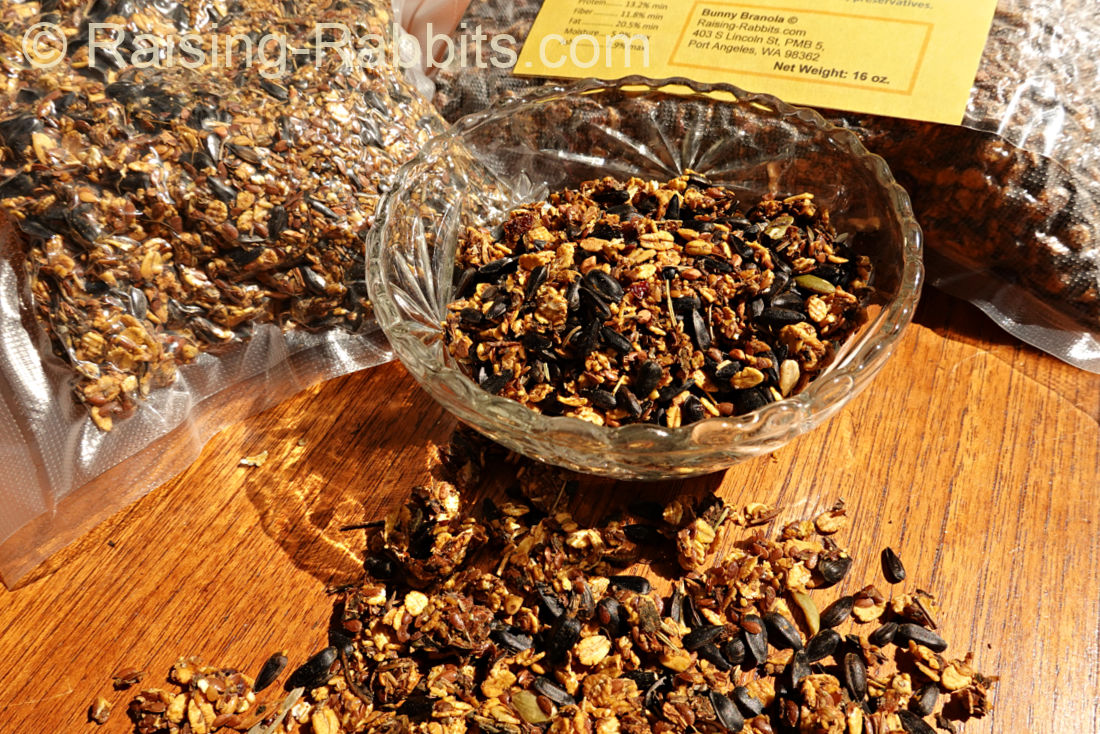
The Ultimate
Rabbit Nutritional Supplement and Treat!
4 delicious flavors! Sample packs available!
Yes! I want more info!
Yes, Buy Bunny Branola Now!
Look What's NEW!!
Our very own classy
Raising Rabbits Sweatshirts, T-shirts, and Hoodies!
 |
 |
 |
.
We're now offering classy, unisex
Raising Rabbits
sweatshirts and hoodies,
Available in a great assortment of colors!
(We have unisex T-shirts too.)
Check out the Bunny Bazaar for our gorgeous
garments!
Order your own today!
They make great gifts too!!
Featured Rabbitries:
Click the Rabbitry Name Links:
Canada, Quebec
MapleRidge Stables Rabbitry
Himalayan Rabbits
Arizona
Hostile Hare
Chinchillas, Cages
Illinois
Open Doors Rabbitry
Lionheads, New Zealands
Kentucky
Goshen Bunnies
Holland Lop and Mini Plush Lop
New Jersey
Go Bunny Treats
All Natural Rabbit Treats
Mini Plush Lop Bunnies
All Natural Rabbit Treats
Belle's Bunny Boutique
Holland Lops & Mini Lion Lops
North Carolina
What The Fluffle Rabbitry
New Zealands, Champagnes
Breadbox Rabbitry
Netherland Dwarfs
The Farm at Fort Mill
Holland Lops
(Right across the South Carolina
border at Charlotte)
Pennsylvania
Happily Ever After
Mini Plush Lops, Holland Lops,
Netherland Dwarf, Lionhead,
Mini Plush Lop, & Mini Rex
Bunnies by Emma and Ellie
Holland Lop, Mini Lop,
Mini Plush Lop,
Mini Rex/Holland Lop Mix
Rhode Island
Shepherds Purse Rabbitry
Holland Lops
South Carolina
Jubilee Farms
Holland Lops
Washington
Cotton Candie Tails
Lionheads, Vienna-Marked
Subscribe to Rabbit Rhythms,
our e-newsletter !
Get rabbit news, husbandry and health tips mostly every month. It's easy - we only need your email address, then hit the 'subscribe' button. Enjoy!
Recent Articles


-
Mama Rabbit Preparing Her Babies Crib
Apr 25, 24 02:55 PM
 I caught my doe busy in her crib making occupation one day. She didn't care for my camera, and certainly seemed to feel uneasy in her mind that I should
 -
Raw Rabbit: Order raw frozen rabbit for pets
Mar 25, 24 07:45 PM
 Raw rabbit. Convenient online ordering of raw frozen rabbit as whole prey, partially processed, or ground, for feeding pets species-appropriate meals
 -
Farm at Fort Mill
Mar 01, 24 03:22 PM
 Farm at Fort Mill has moved. It is now Jubilee Farms Holland Lops, part of Edgemoor Equestrian, in Edgemoor SC. They offer riding lessons and host events.

Raising-Rabbits: Home of
The Rabbit Raising Problem Solver
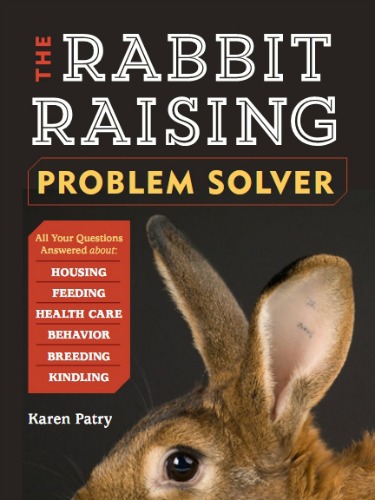
$22.62 - includes
- 10% off your autographed copy of Rabbit Raising Problem Solver
- All packaging, handling, and Media Mail postage costs (WA residents are subject to sales tax)
- Applies to US addresses - (sadly, Media Mail is not offered for international shipping, not even for really awesome books)
- (International shipping is available, of course, but it's out of our control how much they charge for shipping. Send us your country, city, and area code to obtain a shipping quote.)
* Affiliate Links*
As an affiliate of several companies, including Amazon.com, we earn from qualifying purchases. Your purchases from these affiliates come at no extra cost to you.

New! Comments
Have your say about what you just read! Leave me a comment in the box below.