A-Locus Rabbit Colors
A locus rabbit colors. Breed rabbits smartly by understanding
rabbit coat color genetics pertaining to the 2 A-locus color genes carried by
domestic rabbits.
'A' stands for 'Agouti,' meaning, the agouti pattern on a rabbit's hair shaft.
The possible genes of the the A-locus color series are ‘A,’ 'at,’ or ‘a.’ These determine the pattern of the hair shaft, without influencing the actual rabbit color. Agouti rabbits come in many colors, but the one thing that makes them agouti is the banding on the hair shafts. In addition to the bands, the agouti gene (A) also results in a white or ivory belly with a base color of slate-blue or dove-gray ring under the white fur.
The typical 'wild rabbit' look is due to the 'A'
Agouti pattern of rings on the hair shaft. Here is how the rings look
in the case of a chestnut agouti rabbit (A_B_C_D_E_):
- White. At the bottom of the hair shaft nearest the skin, you'll find a very narrow ring of white, if the rabbit is in a prime coat. This ring is only present when the coat is in full condition, and is not often mentioned, except in connection with conditioning or with recognizing a prime rabbit pelt.
- Slate-blue. Meaning, gray. The 'undercoat' is bluish gray, and should constitute roughly 1/2 of the hair shaft.
- Rufus. The middle ring is a rich band of rufus red, also described as "orange," "well-defined orange," or "rich rufus red" in the various ARBA breed Standards of Perfection.
- Black. The hair shaft is tipped with a sliver of black.
The overall effect of the rufus red glistening through the black tipping is one of mahogany or chestnut brown.
The 'A' gene is completely dominant. No matter what the second gene is at the A-locus, an 'A' will override all the effects of the other gene.
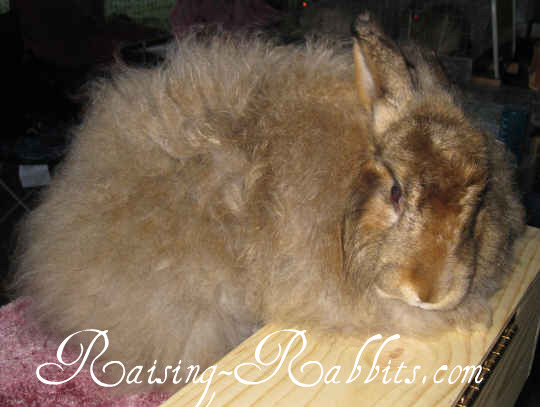
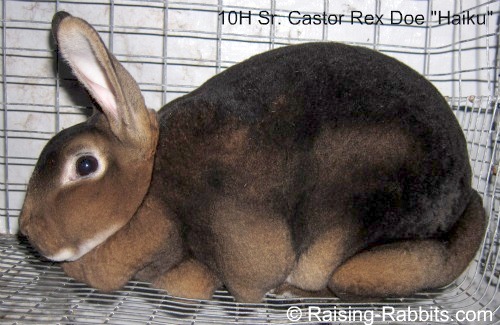
The rabbit needs only one A gene to
produce an agouti patterned hair shaft. Agouti rabbits are:
- Black agoutis: Chestnut, copper, castor, sandy, gray - all names used by various breeds to describe their black-based "A_B_" agouti rabbits.
- Chocolate Agoutis: Chestnut Chocolate, cinnamon (the color, not the breed), amber - all names used by various breeds to describe their "A_b_" chocolate agouti rabbits.
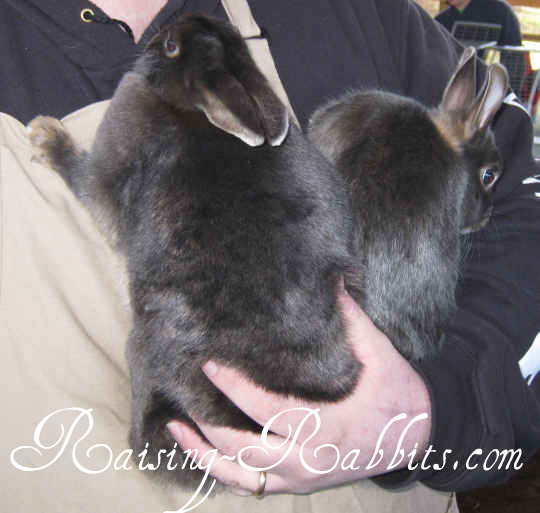
- Dilute blue agoutis:
Opal (blue-based), lynx (lilac-based) - names describing "A_dd" agouti
rabbits with the dilute ‘d’ added.
The rabbits pictured are opal mini-satins. The depth of the opal color is enriched by the satin gene. - Chinchilla-factored and shaded
agoutis: Chinchilla (black), squirrel (blue), chocolate chinchilla,
lilac chinchilla, beige, sable chinchilla, smoke pearl chinchilla, light gray,
steel gray - colors describing the 'A' locus combining with
the B and C genes.
- Non-extension agoutis: Cream,
fawn, red - what you get when you mix the agouti 'A' with
the ‘ee’
non-extension genes. This is tricky, because the
non-extension ('ee') seems to erase the agouti banding.
Though at first sight they might look like selfs ('aa'),
nevertheless a few clues to their 'agouti-hood' remain. For example, creams and
fawns have white bellies to the skin, with no gray undercolor.
- More shaded agoutis: Sable Point, Blue Point, Smoke Pearl Point, Chocolate Point, Lilac Point, Seal, Siamese Sable, Siamese Smoke Pearl, Blue Seal (Dark Smoke Pearl), Frosted Pearl/Frosty, Pearl, Ermine - colors formed by adding various ‘c’ shading genes.
Bunny Branola
The Ultimate Rabbit Conditioning Supplement
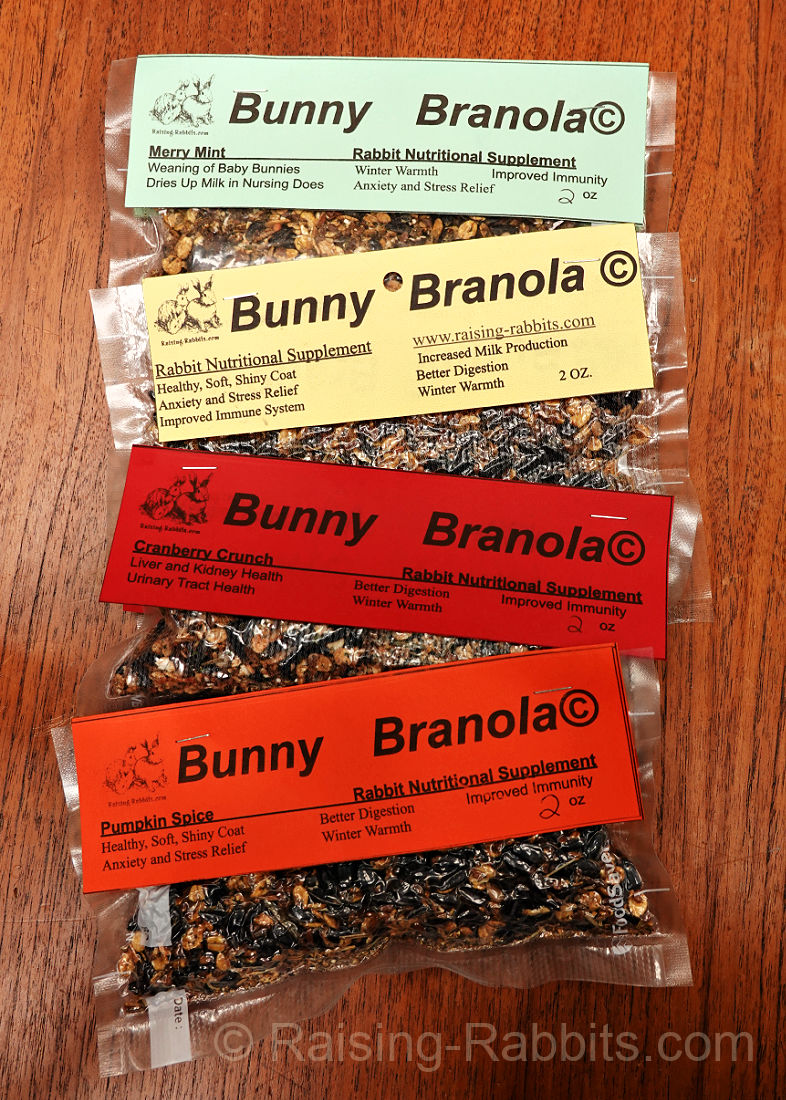 |
Bunny Branola is the ultimate rabbit conditioning supplement. Our specially formulated treat is all natural ingredients from Washington state. No dyes, preservitives, empty fillers, or other chemicals, just pure goodness. Bunny Branola is available in 4 delicious flavors year round: Original Classic (General Health) If you want to find out more about Bunny Branola, including the list of all natural ingredients click HERE. If you are ready to buy now, we have several sizes, just click the one you want. All prices include shipping. Sample: 2 oz - $7 |
Two A-Locus Rabbit Color Mutations
Over time, two additional A-locus rabbit color mutations have occurred, resulting in a total of 3 options at the A-Locus for rabbit colors. Each of these mutations affects pattern, not color.
A-Locus Rabbit Color 'at' = tan pattern
The distinctive tan pattern produces a solid color over the back and the sides. Where the top color meets the belly color is a narrow band the color of the intermediate ring, if the animal still had one (it doesn't). A tan pattern also gives intermediate ring coloration in the ears, the neck triangle, and intermingled coloration on the chest and dewlap. Plus, tans and otters should have intermediate-colored ticking near the junction of top and belly colors.
Tan rabbits (the breed) have fiery red bellies, compliments of the recessive 'ww' wide band recessive gene combination. Ticking is not found in Tan rabbits.
Tan pattern 'at' is recessive to Agouti, but dominant to selfs (‘a’).
A ‘tan pattern’ rabbit carries at least one ‘at.’ The second gene of the A-locus could be either 'at' or ‘a,’ but not 'A' (agouti). Why not 'A'? Because 'A' is completely dominant. If the rabbit carried an ‘A’ with its ‘at,’ the rabbit would be an agouti, as above.
Rabbits with tan-pattern coats are:
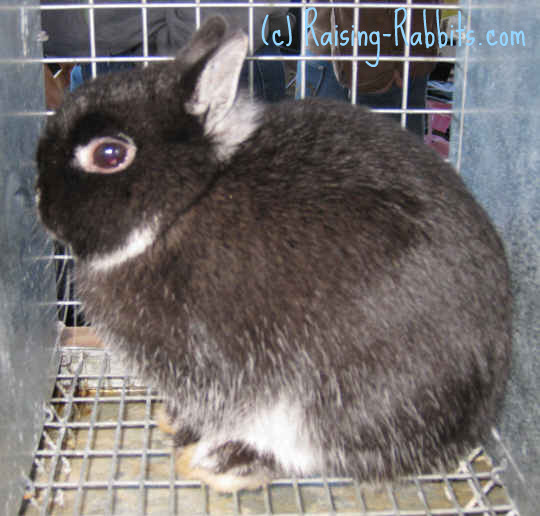
- Otters (black, blue, chocolate, lilac)
- Tans (black, blue, chocolate, lilac). Otters and tans are very similar, however tans also carry modifying factors that redden the belly color.
- Martins (silver martins, sable and smoke pearl martins). Martins carry the at pattern gene plus one of the chinchilla factor ‘c’ genes, which eliminate the yellow color, replacing it with white. The rabbit pictured here is a black martin Netherland Dwarf. His coloration is black, along with silvery white. You can see the white in its ears, neck triangle, belly, and the eye ring.
A-Locus Rabbit Color 'a' = "self" pattern
The 'self' mutation removes all banding whatsoever, leaving a rabbit with one color all over, top to bottom.
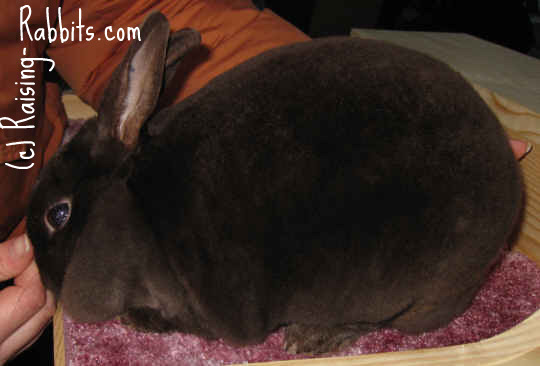
Self is recessive to both tan 'at' and agouti 'A.' Therefore, a self rabbit must carry ‘aa’ at the A locus.
Selfs are black, blue, chocolate, or lilac, depending on the actions of the B, C, D, and E genes.
The rabbit pictured is a chocolate (self) Mini Rex Rabbit.
He is chocolate-colored all over, including the belly, neck triangle and inside
the ears.
Double-Value Guarantee
Our policy is to always OVER-deliver
on value,
which is why your purchase is fully covered by our
Double-Value
Guarantee.
Go ahead - take any of our e-books for a test drive. Peruse our detailed informational and educational e-books. Examine our plans for building rabbit cages, runs, or metal or PVC hutch frames. Check out the Rabbit Husbandry info e-books.
If you aren't completely satisfied that your e-book purchase is worth at least double, triple or even quadruple the price you paid, just drop us a note within 45 days, and we'll refund you the entire cost. That's our Double-Value Guarantee.
Note: When you purchase your
e-books, they will be in PDF format, so you can download them to any device that
supports PDF format. We advise making a back-up copy to a drive or cloud
account. If the books are lost, you can also purchase another copy from Raising-Rabbits.
* Affiliate Links*
As an affiliate of several companies, including Amazon.com, we earn from qualifying purchases. Your purchases from these affiliates come at no extra cost to you.
Bunny Bazaar!
Online Shopping Mall by Raising-Rabbits!
One-Stop Shop for Rabbit Swag for both Buns and Humans
Bunny Branola!
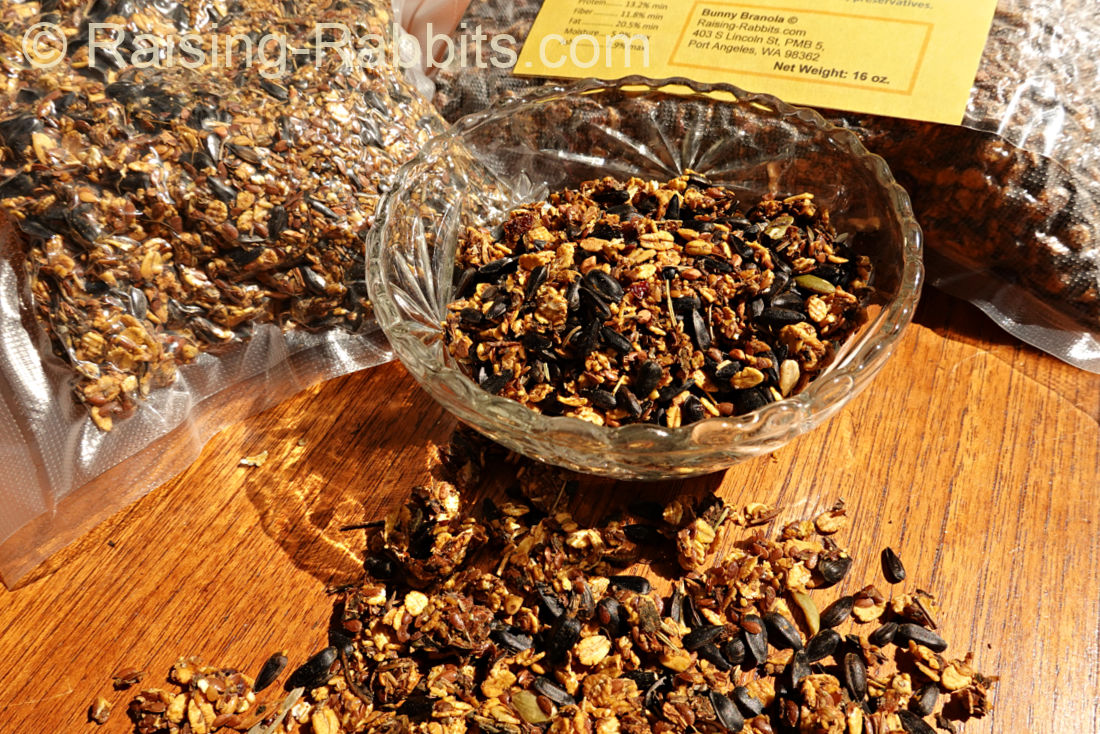
The Ultimate
Rabbit Nutritional Supplement and Treat!
4 delicious flavors! Sample packs available!
Yes! I want more info!
Yes, Buy Bunny Branola Now!
Look What's NEW!!
Our very own classy
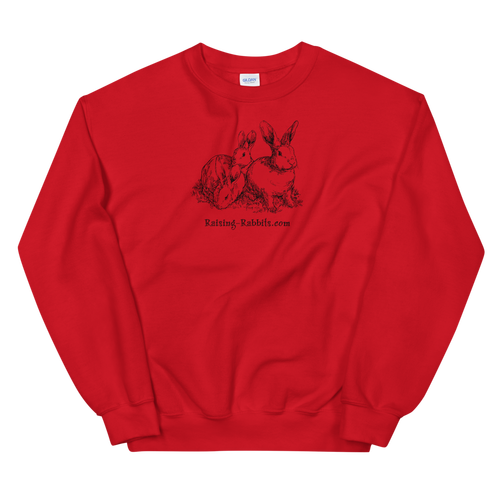
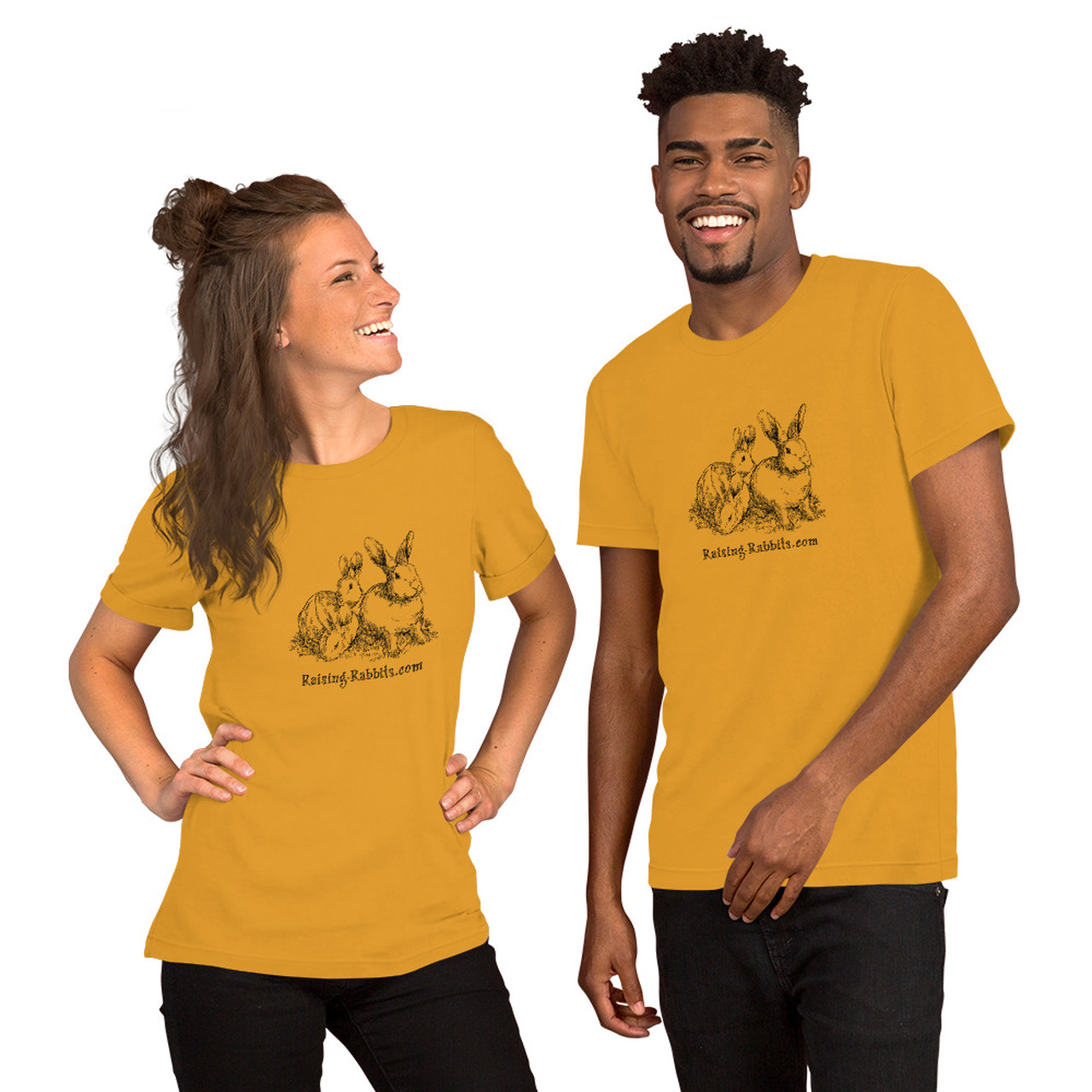
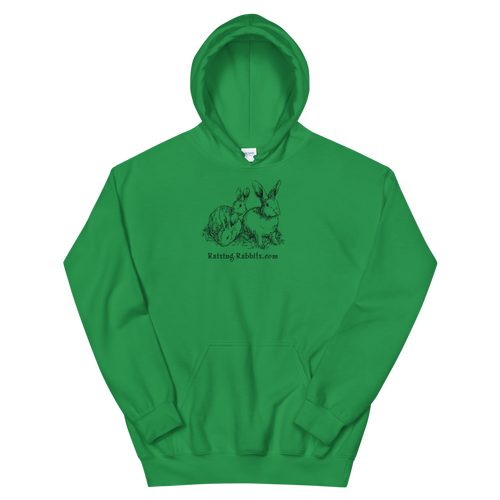
Raising Rabbits Sweatshirts, T-shirts, and Hoodies!
 |
 |
 |
.
We're now offering classy, unisex
Raising Rabbits
sweatshirts and hoodies,
Available in a great assortment of colors!
(We have unisex T-shirts too.)
Check out the Bunny Bazaar for our gorgeous
garments!
Order your own today!
They make great gifts too!!
Featured Rabbitries:
Click the Rabbitry Name Links:
Canada, Quebec
MapleRidge Stables Rabbitry
Himalayan Rabbits
Arizona
Hostile Hare
Chinchillas, Cages
Illinois
Open Doors Rabbitry
Lionheads, New Zealands
Kentucky
Goshen Bunnies
Holland Lop and Mini Plush Lop
New Jersey
Go Bunny Treats
All Natural Rabbit Treats
Mini Plush Lop Bunnies
All Natural Rabbit Treats
Belle's Bunny Boutique
Holland Lops & Mini Lion Lops
North Carolina
What The Fluffle Rabbitry
New Zealands, Champagnes
Breadbox Rabbitry
Netherland Dwarfs
The Farm at Fort Mill
Holland Lops
(Right across the South Carolina
border at Charlotte)
Pennsylvania
Happily Ever After
Mini Plush Lops, Holland Lops,
Netherland Dwarf, Lionhead,
Mini Plush Lop, & Mini Rex
Bunnies by Emma and Ellie
Holland Lop, Mini Lop,
Mini Plush Lop,
Mini Rex/Holland Lop Mix
Rhode Island
Shepherds Purse Rabbitry
Holland Lops
South Carolina
Jubilee Farms
Holland Lops
Washington
Cotton Candie Tails
Lionheads, Vienna-Marked
Subscribe to Rabbit Rhythms,
our e-newsletter !
Get rabbit news, husbandry and health tips mostly every month. It's easy - we only need your email address, then hit the 'subscribe' button. Enjoy!
Recent Articles


-
Mama Rabbit Preparing Her Babies Crib
Apr 25, 24 02:55 PM
 I caught my doe busy in her crib making occupation one day. She didn't care for my camera, and certainly seemed to feel uneasy in her mind that I should
 -
Raw Rabbit: Order raw frozen rabbit for pets
Mar 25, 24 07:45 PM
 Raw rabbit. Convenient online ordering of raw frozen rabbit as whole prey, partially processed, or ground, for feeding pets species-appropriate meals
 -
Farm at Fort Mill
Mar 01, 24 03:22 PM
 Farm at Fort Mill has moved. It is now Jubilee Farms Holland Lops, part of Edgemoor Equestrian, in Edgemoor SC. They offer riding lessons and host events.


Raising-Rabbits: Home of
The Rabbit Raising Problem Solver
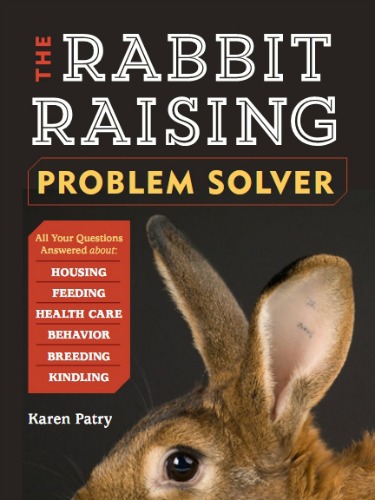
$22.62 - includes
- 10% off your autographed copy of Rabbit Raising Problem Solver
- All packaging, handling, and Media Mail postage costs (WA residents are subject to sales tax)
- Applies to US addresses - (sadly, Media Mail is not offered for international shipping, not even for really awesome books)
- (International shipping is available, of course, but it's out of our control how much they charge for shipping. Send us your country, city, and area code to obtain a shipping quote.)
* Affiliate Links*
As an affiliate of several companies, including Amazon.com, we earn from qualifying purchases. Your purchases from these affiliates come at no extra cost to you.

New! Comments
Have your say about what you just read! Leave me a comment in the box below.