Rabbit Food
Rabbit Food: Need to save money or avoid risky GMO rabbit pellets? Switch to non-pelleted, non-GMO alfalfa, yard clippings and green forages. Fresh, all natural rabbits food is ideal for your rabbits' optimum health.
"People have raised rabbits for hundreds of years without the availability of a complete pelleted rabbit feed. Certainly it is possible to feed rabbits without pellets today?"
Yes, it is possible. Very possible.
We can think of at least 2 reasons why the backyard breeder might seriously consider shifting from pellets to non-pelleted rabbit food:
- Cost. Yikes -
pellets in some parts of the USA cost $20+ per 50-pound bag, and you
can add tax and shipping on top of that.
- Possibly dangerous, genetically modified (GMO) ingredients have found their way into our rabbit pellets, most notably corn and soybeans. Is GMO safe? The studies sponsored by Monsanto say yes. Of course. But don't believe it...yet. Unbiased scientific research is reporting some frightening stuff. We'll present the research results that the GMO industry bigwigs are viciously trying to suppress, soon.
Both of these factors are
propelling Aurora Rex Rabbit Ranch to explore the feasibility of
stopping with the pellets and converting our rabbit food to a variety of
alfalfa, forages and green foods. And from the feedback our visitors
give us, we think we're not the only ones!
Learn More - SayNoToGMOs.org
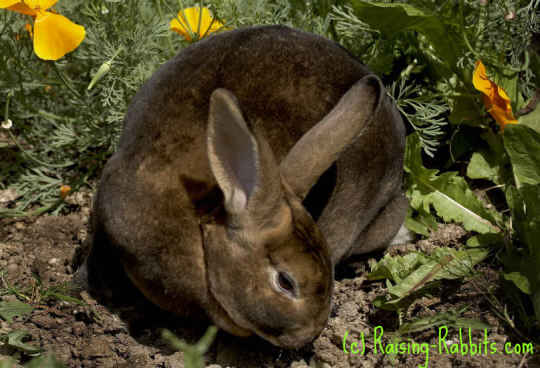
Want to try your hand at feeding non-pelleted rabbit food?
The ability of rabbits to recycle their dinner via coprophagy means they can subsist on relatively poor forages in nature. The chances are good that your rabbits will do fine as you get better and better at feeding them a balanced ration.
But, since your rabbits do depend entirely on YOU to provide all they need, you'll still want to...
- Familiarize yourself with the forages and plants in your area that are safe for rabbits. We hope our list of Pet-Safe Plants will help. And...
- Brush up on your knowledge of rabbits' nutritional needs
Rabbit Production, 1996 Edition
We strongly recommend that you purchase a copy of Rabbit Production, 6th Edition or newer, as this resource gives researched guidelines on rabbits' nutritional needs. Now you can easily figure out how to supply the nutrition your rabbits need. The book will serve you well for many years. We bought our copy years ago -- it is still an excellent resource today.
We probably don't need to mention this, but...any time the rabbit farmer uses more than just pellets to feed the rabbits, the labor hours mount and life gets more complicated. The owner of a large commercial rabbitry might want to think long and hard before moving away from pellets as a complete rabbit food.
But for many folks around the globe who raise rabbits for hobby, show and meat rabbits in the back yard, the idea is worth serious consideration. This is why we researched the non-pelleted needs of rabbits at length, and put all the information into an easy to use PDF format for your benefit.
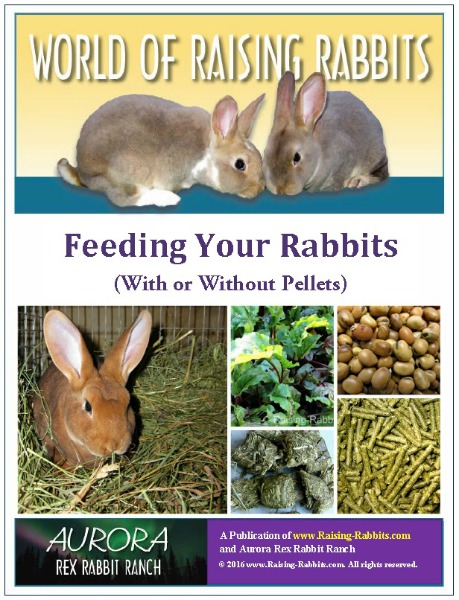
FEEDING YOUR RABBITS
Feeding Your Rabbits is our guide on everything you need to know about a healthy rabbit diet. It includes information about store pellet feed or a home forage diet so you can choose the right fare for your hare.
Feeding Your Rabbits tells you how to feed your rabbits at all stages of life, including bottle feeding newborn babies, extra nutrition for pregnant and nursing does, supplements to enhance health, and even which plants are safe, and which are safe in moderation. Feeding Your Rabbits also has information regarding rabbit digestive health and diseases. A healthy diet will ensure your rabbit lives his best life!
Summer sale:
30% Discount on All E-Books!!!
BUY NOW! Only $12.99 $8.99
To find out about all of our great books, check out our BOOKSTORE.
Your purchase is 100% Risk Free. See our Double-Value Guarantee below.
Rabbit Food Experiment at
Aurora Rex Ranch
A couple years ago, we wanted to know what would happen, and if it was even possible, to feed rabbits on yard scraps alone. To find out, we placed a pregnant doe into a very large outside cage (36 inches by 48 inches) and fed her on our yard scraps and grass clippings.
In due time she kindled a litter of 8 very nice sized kits.
On yard scraps alone, she was not able to produce enough milk for the kits. As the days went by, the kits began to look thin and hungry. We feel they would have died had we not intervened. When the kits were about one week old, we began offering pellets to the doe, along with the dandelions, weeds, grass clippings, yard scraps and woody twigs and leaves. The kits began to thrive.
At 14 days we removed the nestbox as usual. The kits immediately began nibbling on all the forages that their mama was eating, with no ill effects whatsoever.
Nutritional Analysis of:
Alfalfa Hay ~~~~~~ and ~~~~~~ Timothy Hay
Carbs = 17% ....................................... 8.6%
Fats = ................................................. 1.5%
Protein = 17% - 20% ........................... 7% - 11%
Fiber = 20.8% - 27.3% ......................... 32%
Sources:
http://hayandfeedranch.com/hay_education.htm
http://www.alfalfaking.com/timothy-hay/
http://animalscience.uconn.edu/extension/publications/hayanalysis.htm
Because this extra-large cage was intended to contain large rabbits, we
had originally constructed it of 2" x 4" wire mesh. For the kits, we
added smaller, 1x2 wire to all 4 sides to contain the growing kits, but
the little buggers can climb! One morning we found that they had all
escaped the cage through the 2x4 top wire. From the age of 5 weeks and for the next several
weeks, these kits fended for themselves, darting away from us but
staying close to the cage, unable to figure out how to get back into the
cage with the mama. They did fine, health-wise!
When we finally
managed to catch them all, their weights were fully one pound less than
traditionally pellet-fed kits of the same age (9 weeks). They were
lean, muscular, and very healthy.
And that's the trade-off you
may need to consider should you choose to do away with commercial rabbit
pellets -- your rabbits will be healthy, but may or may not gain weight as
quickly or as steadily as they would on pellets, if the nutrient balance
is not just right. And, they may not top out at full senior weights.
That said, I know of several breeders whose rabbits haven't seen pellets
in 18 months, yet their offspring are hitting senior weights at 5
months old (a month early) and are in peak health and condition.
It can be done, and it can be done exceptionally well, when you do your homework and understand the rabbits' nutrient needs. For example, our doe needed more protein in order to produce enough milk, and alfalfa hay would have supplied sufficient protein.
Pellets are nothing more than a concoction of rabbit food that answers all the needs of the rabbit. If you can adequately fill all those needs, your rabbits are likely to do even better than they do on pellets alone, due to the freshness of the forages. [I believe that fresh green feeds might actually strengthen the immune system on those rabbits with marginal health.]
Rabbits are versatile. They can run their food through a second time to extract even more nutrients the second time around. They'll be fine as you practice, and then master, the art of feeding non-pelleted, all natural rabbit food.
Rabbit Condition Enhancers: BOSS, Whole Oats (#ad)
Nutritional Analysis of:
Black Oil Sunflower Seeds (BOSS) ~ and ~ Whole Oats
Carbs = 13%.................................................. 70%
Fats = 77%..................................................... 15%
Protein = 10%............................................... 15%
Source: http://nutritiondata.self.com/
Plan A: Rabbit Food Without Pellets
Your rabbits will likely do very well without pellets, if you can supply a balanced ration that meets the protein, fiber, carbohydrate (energy), fat and mineral needs of your rabbits. This is where Rabbit Production comes in sooo handy.
The basis of the rabbit food should be alfalfa hay, fed free choice, IF you can obtain the non-GMO variety. If not, use grass hay such as timothy along with high-protein forages.
When I wrote this page several years ago, GMO alfalfa was still just a glint in Monsanto's eye. The use of GMO alfalfa was deregulated in the USA in 2011. Dozens of countries around the globe now refuse to import GMO alfalfa because its use results in reproductive disorders and cancers, and failure to thrive or reproduce in some species.
Supplement the alfalfa with a wide variety of rabbit-safe, locally grown, organic, pesticide-free, non-GMO green stuff and branches:
- Vegetables, fruits (in extreme moderation)
- Herbs, flowers, berries, brambles
- Grass hays
- Grains and grain hays
- Grass clippings
- Yard scraps and cuttings
- Leaves and branches of safe trees (helps provide chewing opportunity which helps keep teeth worn evenly)
- Your choices will present themselves seasonally, and this is fine. Supplement with black oil sunflower seeds as needed
- You'll need to familiarize yourself with plants that are safe and edible, and those that are not. Consult our Pet Safe Plants page for a head-start on your botany info.
- Green forages are very high in water - from 65% to over 90%. Your rabbits' water needs will nearly disappear, at least during the months you can feed the fresh green stuff.
- Provide each cage with a mineralized salt ring. The salt can corrode the cage wire, so if possible, suspend it in such a way that it doesn't come into contact with the wire, such as from the top of the cage.
- Whatever the doe can eat, so can her kits. The reasons in this case are twofold: Firstly, the doe's intestinal flora balances itself to handle the forages she eats, and she passes her flora population to her kits through her cecotropes. And secondly, without the rich food content of pellets, there is much less danger of dysbiosis (resulting in diarrhea) in the kits.
Plan B: Half and Half -
Pellets and Non-pelleted Rabbit Food
According to Rabbit Production, "If palatable greens are fed free choice, the amount of pelleted feed used can be reduced by about 50%, with no adverse effects on performance" (6th Ed, pg. 173).
For Plan B, follow Plan A and offer (non-GMO) pellets as well.
You can cut the pellet ration in half, eventually offering what the animals will clean up without leftovers.
Feeding half the usual pellet ration and supplementing with green forages and grain might be the best of both worlds.
- You'll save money by buying less pellets
- Yard clippings are free, and if you can plant your own alfalfa and forages, all the better (and cheaper)
- You won't have to worry about adding minerals or salt as the pellets and fresh greens will provide sufficient minerals.
FEEDING YOUR RABBITS
Feeding Your Rabbits is our guide on everything you need to know about a healthy rabbit diet. It includes information about store pellet feed or a home forage diet so you can choose the right fare for your hare.
Feeding Your Rabbits tells you how to feed your rabbits at all stages of life, including bottle feeding newborn babies, extra nutrition for pregnant and nursing does, supplements to enhance health, and even which plants are safe, and which are safe in moderation. Feeding Your Rabbits also has information regarding rabbit digestive health and diseases. A healthy diet will ensure your rabbit lives his best life!
Summer sale:
30% Discount on All E-Books!!!
BUY NOW! Only $12.99 $8.99
To find out about all of our great books, check out our BOOKSTORE.
Your purchase is 100% Risk Free. See our Double-Value Guarantee below.
Who Else is Feeding
Green Forages as rabbit food?
Polyface Farm in the Shenandoah Valley of Virginia has been raising pastured rabbits for years. This environmentally friendly farm uses some non-GMO pellets along with forages. Fryers spend their last 6 weeks in movable "field shelters," from 6 weeks of age to 12 weeks. With fresh grass to graze, pelleted feed consumption plummets.
More on raising rabbits at Polyface from the blog:
Life As A Polyface Apprentice
Polyface Farm is waaay ahead of the curve and has a lot to teach the world about sustainable farming and about treating the earth - and the animals - wisely and kindly.
Here's a brief introduction to Polyface via a 4-minute YouTube video....
Double-Value Guarantee
Our policy is to always OVER-deliver
on value,
which is why your purchase is fully covered by our
Double-Value
Guarantee.
Go ahead - take any of our e-books for a test drive. Peruse our detailed informational and educational e-books. Examine our plans for building rabbit cages, runs, or metal or PVC hutch frames. Check out the Rabbit Husbandry info e-books.
If you aren't completely satisfied that your e-book purchase is worth at least double, triple or even quadruple the price you paid, just drop us a note within 45 days, and we'll refund you the entire cost. That's our Double-Value Guarantee.
Note: When you purchase your
e-books, they will be in PDF format, so you can download them to any device that
supports PDF format. We advise making a back-up copy to a drive or cloud
account. If the books are lost, you can also purchase another copy from Raising-Rabbits.
Double-Value Guarantee
Our policy is to always OVER-deliver
on value,
which is why your purchase is fully covered by our
Double-Value
Guarantee.
Go ahead - take any of our e-books for a test drive. Peruse our detailed informational and educational e-books. Examine our plans for building rabbit cages, runs, or metal or PVC hutch frames. Check out the Rabbit Husbandry info e-books.
If you aren't completely satisfied that your e-book purchase is worth at least double, triple or even quadruple the price you paid, just drop us a note within 45 days, and we'll refund you the entire cost. That's our Double-Value Guarantee.
Note: When you purchase your
e-books, they will be in PDF format, so you can download them to any device that
supports PDF format. We advise making a back-up copy to a drive or cloud
account. If the books are lost, you can also purchase another copy from Raising-Rabbits.
* Affiliate Links*
As an affiliate of several companies, including Amazon.com, we earn from qualifying purchases. Your purchases from these affiliates come at no extra cost to you.
Bunny Bazaar!
Online Shopping Mall by Raising-Rabbits!
One-Stop Shop for Rabbit Swag for both Buns and Humans
Bunny Branola!
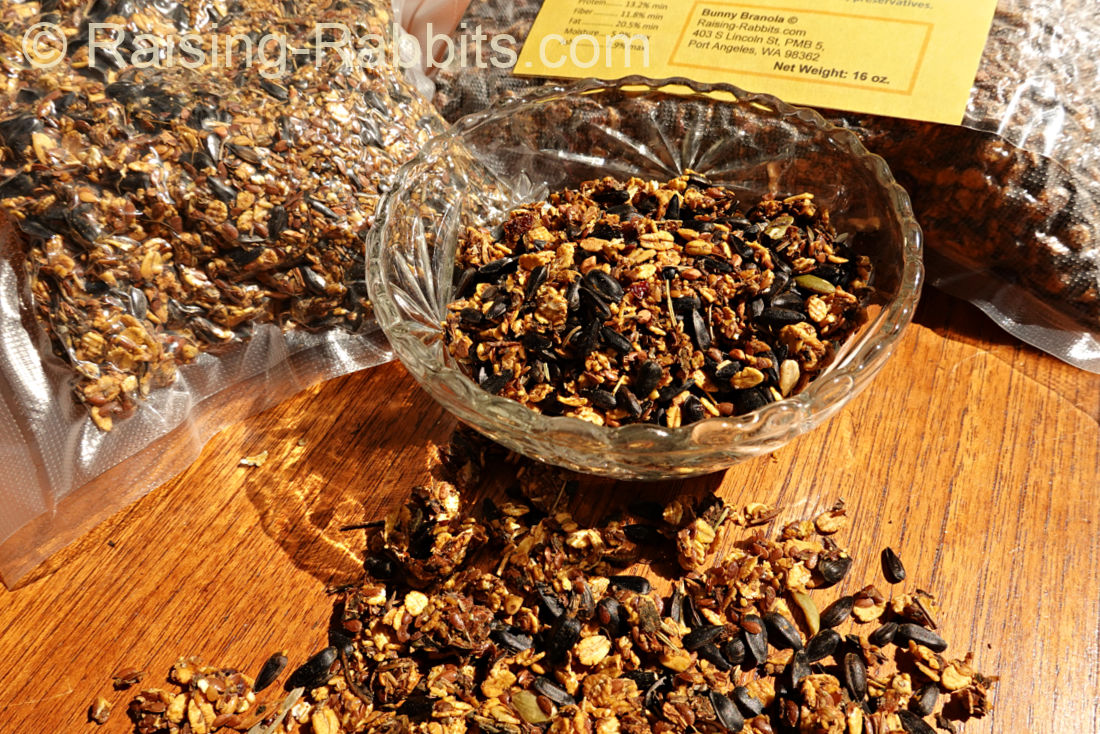
The Ultimate
Rabbit Nutritional Supplement and Treat!
4 delicious flavors! Sample packs available!
Yes! I want more info!
Yes, Buy Bunny Branola Now!
Look What's NEW!!
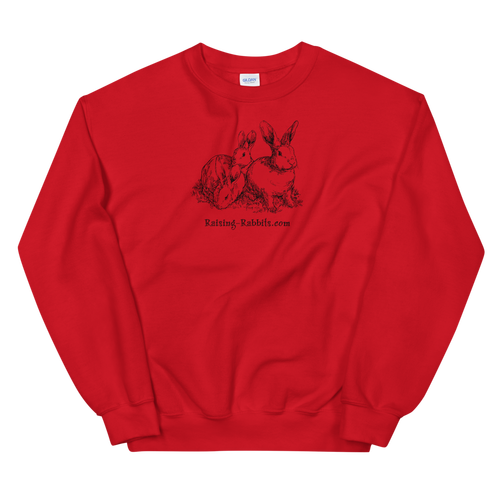
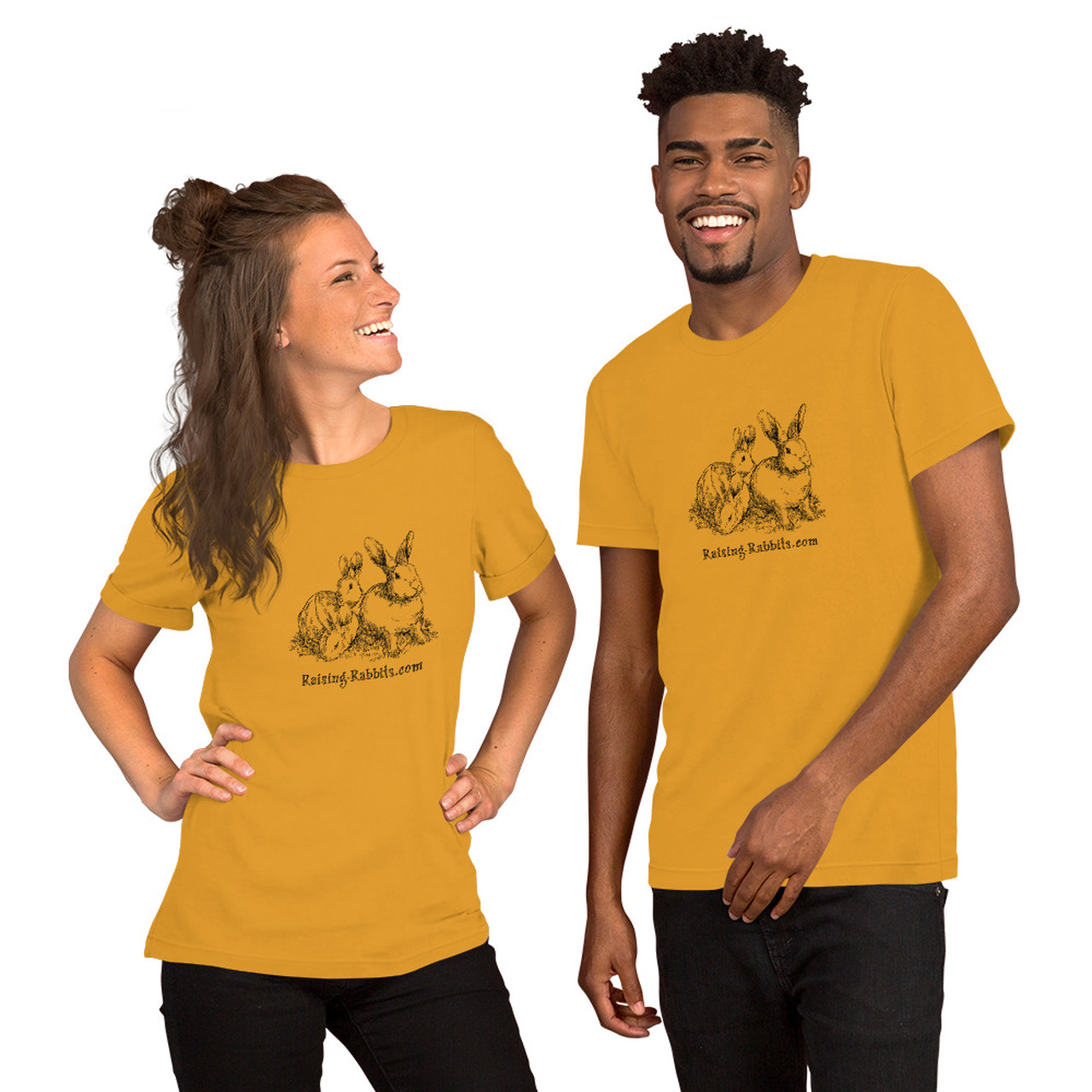
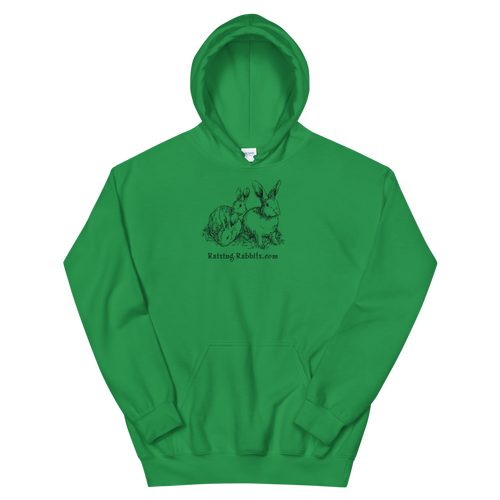
Our very own classy
Raising Rabbits Sweatshirts, T-shirts, and Hoodies!
 |
 |
 |
.
We're now offering classy, unisex
Raising Rabbits
sweatshirts and hoodies,
Available in a great assortment of colors!
(We have unisex T-shirts too.)
Check out the Bunny Bazaar for our gorgeous
garments!
Order your own today!
They make great gifts too!!
Featured Rabbitries:
Click the Rabbitry Name Links:
Canada, Quebec
MapleRidge Stables Rabbitry
Himalayan Rabbits
Arizona
Hostile Hare
Chinchillas, Cages
Illinois
Open Doors Rabbitry
Lionheads, New Zealands
Kentucky
Goshen Bunnies
Holland Lop and Mini Plush Lop
New Jersey
Go Bunny Treats
All Natural Rabbit Treats
Mini Plush Lop Bunnies
All Natural Rabbit Treats
Belle's Bunny Boutique
Holland Lops & Mini Lion Lops
North Carolina
What The Fluffle Rabbitry
New Zealands, Champagnes
Breadbox Rabbitry
Netherland Dwarfs
The Farm at Fort Mill
Holland Lops
(Right across the South Carolina
border at Charlotte)
Pennsylvania
Happily Ever After
Mini Plush Lops, Holland Lops,
Netherland Dwarf, Lionhead,
Mini Plush Lop, & Mini Rex
Bunnies by Emma and Ellie
Holland Lop, Mini Lop,
Mini Plush Lop,
Mini Rex/Holland Lop Mix
Rhode Island
Shepherds Purse Rabbitry
Holland Lops
South Carolina
Jubilee Farms
Holland Lops
Washington
Cotton Candie Tails
Lionheads, Vienna-Marked
Subscribe to Rabbit Rhythms,
our e-newsletter !
Get rabbit news, husbandry and health tips mostly every month. It's easy - we only need your email address, then hit the 'subscribe' button. Enjoy!
Recent Articles


-
Mama Rabbit Preparing Her Babies Crib
Apr 25, 24 02:55 PM
 I caught my doe busy in her crib making occupation one day. She didn't care for my camera, and certainly seemed to feel uneasy in her mind that I should
 -
Raw Rabbit: Order raw frozen rabbit for pets
Mar 25, 24 07:45 PM
 Raw rabbit. Convenient online ordering of raw frozen rabbit as whole prey, partially processed, or ground, for feeding pets species-appropriate meals
 -
Farm at Fort Mill
Mar 01, 24 03:22 PM
 Farm at Fort Mill has moved. It is now Jubilee Farms Holland Lops, part of Edgemoor Equestrian, in Edgemoor SC. They offer riding lessons and host events.

Raising-Rabbits: Home of
The Rabbit Raising Problem Solver
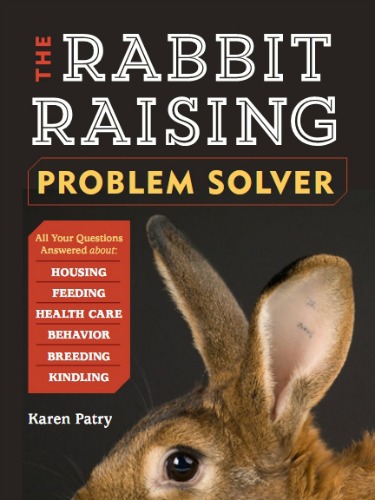
$22.62 - includes
- 10% off your autographed copy of Rabbit Raising Problem Solver
- All packaging, handling, and Media Mail postage costs (WA residents are subject to sales tax)
- Applies to US addresses - (sadly, Media Mail is not offered for international shipping, not even for really awesome books)
- (International shipping is available, of course, but it's out of our control how much they charge for shipping. Send us your country, city, and area code to obtain a shipping quote.)
* Affiliate Links*
As an affiliate of several companies, including Amazon.com, we earn from qualifying purchases. Your purchases from these affiliates come at no extra cost to you.

New! Comments
Have your say about what you just read! Leave me a comment in the box below.