Rabbit Teeth
Rabbit teeth keep growing throughout the rabbit's whole life. It takes a lot of daily chewing and gnawing to keep them worn down to usable lengths.
The top two teeth should overlap the bottom two teeth. This way, as the rabbit chews - hay, wood, bark, pellets, carrots, toys, your furniture - the teeth wear each other down evenly.
In addition to these front teeth, rabbits have two more teeth, called peg teeth, directly behind the two upper incisors, and a full set of molars in the back of the jaw which they use to masticate their high-fiber food.
The front incisors, peg teeth, and molars grow throughout the rabbit’s life. Rabbits have to chew stuff in order to wear them down and keep them maintained at a correct (short) length. When the uppers and lowers don’t meet correctly, or if the rabbit doesn't chew enough, they don’t wear each other down. The result is wolf teeth, or more correctly, malocclusion. Another name for maloccluded teeth is 'buck teeth.'
Malocclusion in youngsters is seen as early as 3 weeks of age, and varies in severity. The incisors may be frankly misaligned with the lower incisors protruding beyond the upper incisors. Or, they may abut straight on. Unless very severe, malocclusion in youngsters will frequently correct itself by 10 weeks old as the upper jaw catches up in growth to the lower jaw.
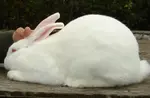
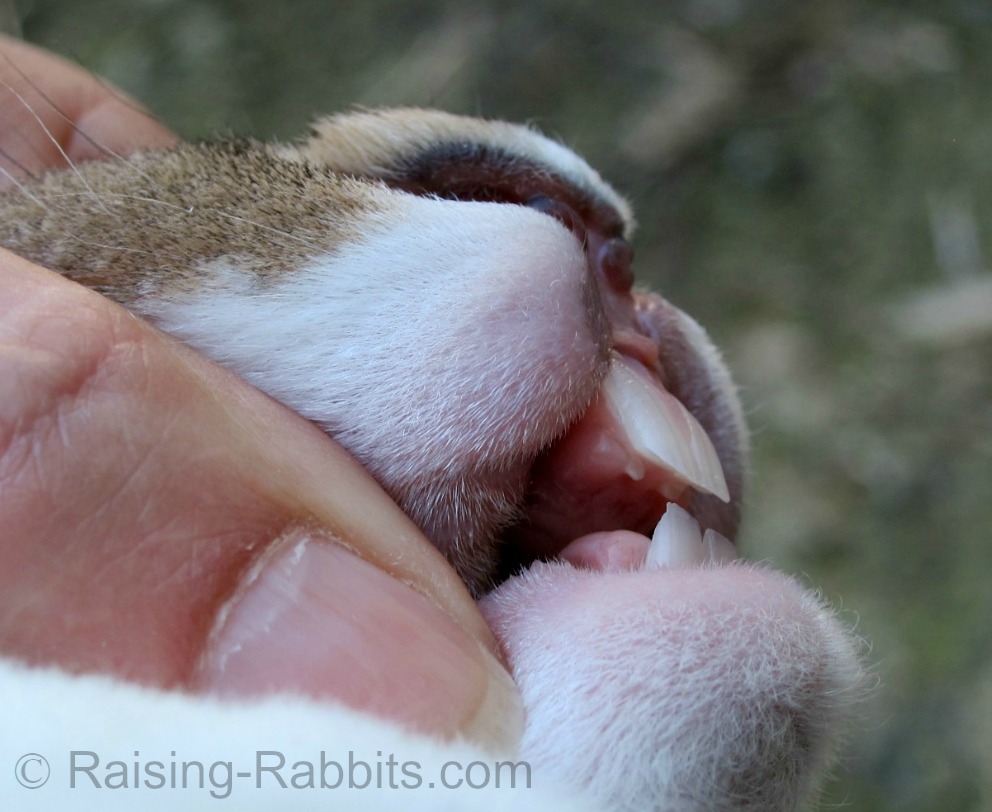 This rabbit has perfectly aligned rabbit teeth. The little peg teeth behind the upper incisors are visible, and are what help chisel the lower incisors into proper wedges.
Rabbit Teeth Malocclusion
Geneticists believe that malocclusion in youngsters is a heritable disease. Some controversy exists as to just how the inheritance occurs, whether caused by a simple recessive gene and additional modifiers, or several genes. Most researchers tend to accept the former.
At any rate, a single recessive gene by itself does not explain the multiple degrees of genetic malocclusion. Whether genes or modifiers, it seems likely that several factors must 'align' in the genetic code of a rabbit in order to produce malocclusion, and if three or four conditions are suitable but a fifth is not, the rabbit will not present with malocclusion.
But, breed this animal with 'perfect' teeth carrying malocclusion in 4 of 5 modifiers to a rabbit with 'perfect' teeth except for that single modifier the mate is missing, and you could be surprised by kits with frank malocclusion.
This is the current hypothesis, anyways.
Trauma
Some rabbits develop buck teeth by yanking on the cage wire, disturbing the alignment in their teeth. This is not a genetic problem, but a physical one. Sometimes the resulting buck teeth condition is permanent, but sometimes the rabbit heals itself.
Getting dropped and breaking the jaw can also result in malocclusion. Consult your rabbit-savvy vet.
Rabbit Production, 10th Edition
This Important Scientific Resource is Available in Paperback, Hardcover, and Kindle. Prior Editions are Equally Useful if Newer Editions are Scarce.
New Onset Malocclusion in Adults
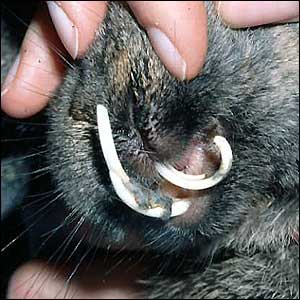 Advanced, and life-threatening, malocclusion
A more serious form of malocclusion occurs in adult rabbits, which may not be genetically related. Dietary problems such as not enough calcium, Vitamin D, or roughage can combine with too many calories, and cause a variety of problems.
- Calcium and Vitamin D deficiency can soften the facial bones, allowing the rabbit's teeth to eventually be pressured out of alignment in adulthood.
- Too many calories and not enough roughage may quickly contribute to not enough chewing, as the rabbit is soon satisfied.
- Malocclusion in older rabbits is frequently accompanied by other dental problems, such as abscesses, and overgrowth of the molars affecting the incisors, putting pressure on the tear ducts.
Pet rabbits seem to be prone to adult-onset malocclusion.
How to Check Rabbit Teeth
Spread the corners of the rabbit’s mouth into a smile, as in the first picture above. This reveals both the upper and the lower incisors. You want to see the uppers overlapping the lowers. In youngsters, if they abut exactly, the alignment may correct itself in a few weeks; check them again later.
If the lower teeth meet the upper teeth on the outside, this may not self-correct. Keep a close eye on the rabbit. If this is an adult rabbit, you may already see that the teeth are growing too long.
What you see:
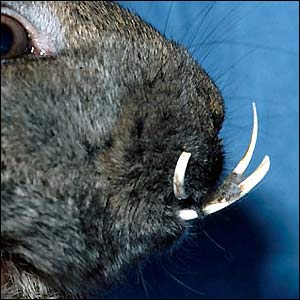 Advanced, life-threatening, malocclusion
Rabbit teeth that are excessively long, usually with the lower teeth growing to the outside of the upper teeth.
Pictured here is a very bad case of malocclusion. The teeth have been allowed to become severely overgrown. Since the teeth grow at a rate of roughly 1/2 inch per month, it only takes a few months for the teeth to become this overgrown. This animal probably cannot chew without a tooth digging into his flesh somewhere.
Additionally, though not visible in this photo, the rabbit's molars in the back of its mouth may also be maloccluded and overgrowing due to improper alignment and inability of this rabbit to properly chew.
Two Creative, XL-Sized Indoor Rabbit Cages. Recommended!
--Ferplast Krolik XXL Indoor Rabbit Cage with Double Extras (#ads)
Is it possible to eliminate the genes for maloccluded rabbit teeth from the herd entirely?
Malocclusion is usually a complex genetic syndrome. Rabbit breeders should cull all offspring that clearly exhibit buck teeth. But it is unlikely that the breeder can simply cull a few animals and call it a day.
Since the jury is still out as to the exact mode of inheritance, you might want to repeat the breeding to settle the question of whether or not the buck teeth are genetic, or due to some injury, especially if just one rabbit in a litter turns up with crooked rabbit teeth.
If the problem is indeed genetic, the breeder may wish to cull the parents, and then continuously select for breeding stock only those offspring with ideal alignment at 4-6 weeks.
In much the same way as a breeder can nearly eliminate susceptibility to snuffles in his herd through consistent culling, we think the series of unknown genes or modifiers that together produce malocclusion can equally be eliminated. Just keep using for breeding the rabbits that have ideal teeth alignment. Yes, it might take up to several years, but many breeders have accomplished this task.
Learn More:
AT Home Pets Blog Post - Annette at AT Home Pets has posted an informative article on malocclusion in pet rabbits, linking to additional information. We recommend checking it out if you need to know more.
Below: Comprehensive health and disease info in Part 4 of Rabbit Raising Problem Solver
Raising-Rabbits: Home of
The Rabbit Raising Problem Solver
All your Answers in One Book!
Learn More Here
$22.62 - Order Here
Go from Rabbit Teeth to Rabbit Health
Check out our Rabbit Health and Diseases E-Book

Keep Your Rabbits Healthy!
How to Improve Health and Conquer Common Rabbit Diseases
Get More Info on Keeping Your Rabbits Healthy
As always, your purchase is 100% risk free. See our Double Value Guarantee below.
Raising rabbits? Consider a membership to the American Rabbit Breeders Association
Double-Value Guarantee
Our policy is to always OVER-deliver
on value,
which is why your purchase is fully covered by our
Double-Value
Guarantee.
Go ahead - take any of our e-books for a test drive. Peruse our detailed informational and educational e-books. Examine our plans for building rabbit cages, runs, or metal or PVC hutch frames. Check out the Rabbit Husbandry info e-books.
If you aren't completely satisfied that your e-book purchase is worth at least double, triple or even quadruple the price you paid, just drop us a note within 45 days, and we'll refund you the entire cost. That's our Double-Value Guarantee.
Note: When you purchase your
e-books, they will be in PDF format, so you can download them to any device that
supports PDF format. We advise making a back-up copy to a drive or cloud
account. If the books are lost, you can also purchase another copy from Raising-Rabbits.
Double-Value Guarantee
Our policy is to always OVER-deliver
on value,
which is why your purchase is fully covered by our
Double-Value
Guarantee.
Go ahead - take any of our e-books for a test drive. Peruse our detailed informational and educational e-books. Examine our plans for building rabbit cages, runs, or metal or PVC hutch frames. Check out the Rabbit Husbandry info e-books.
If you aren't completely satisfied that your e-book purchase is worth at least double, triple or even quadruple the price you paid, just drop us a note within 45 days, and we'll refund you the entire cost. That's our Double-Value Guarantee.
Note: When you purchase your
e-books, they will be in PDF format, so you can download them to any device that
supports PDF format. We advise making a back-up copy to a drive or cloud
account. If the books are lost, you can also purchase another copy from Raising-Rabbits.
* Affiliate Links*
As an affiliate of several companies, including Amazon.com, we earn from qualifying purchases. Your purchases from these affiliates come at no extra cost to you.
Bunny Bazaar!
Online Shopping Mall by Raising-Rabbits!
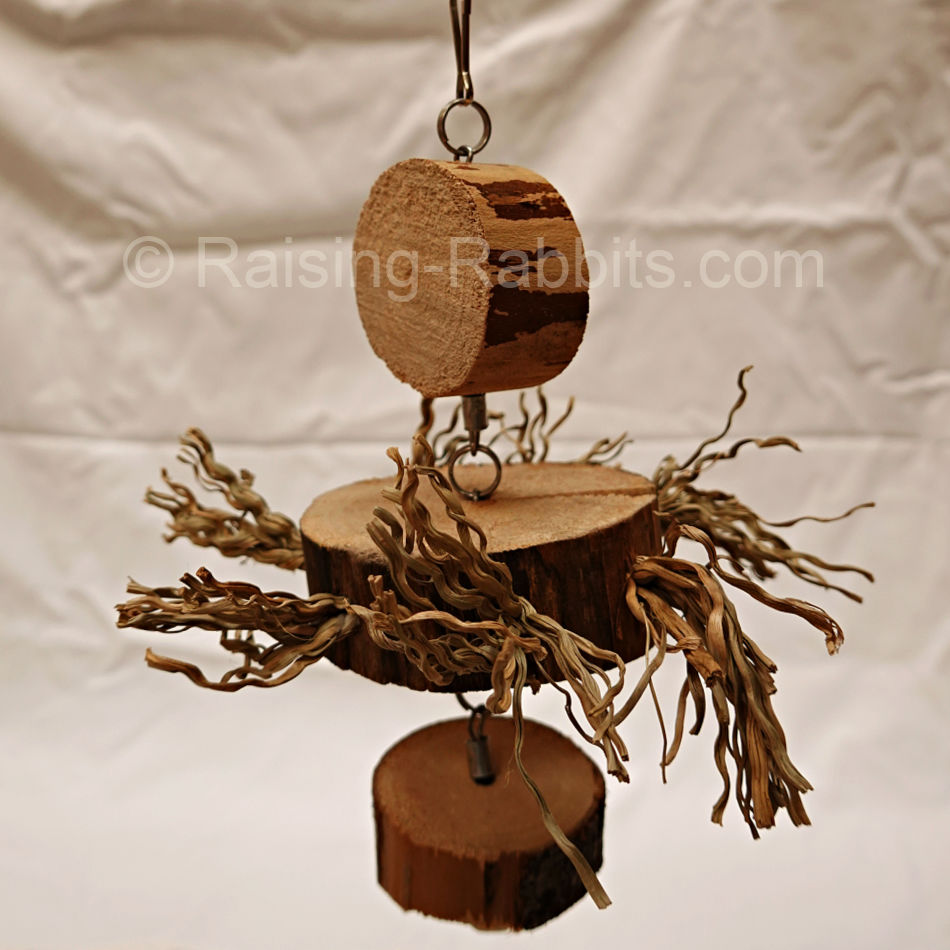
One-Stop Shop for Rabbit Swag for both Rabbits and Humans
Bunny Branola:
Immune-Boosting Rabbit Nutritional Supplement and Treat!
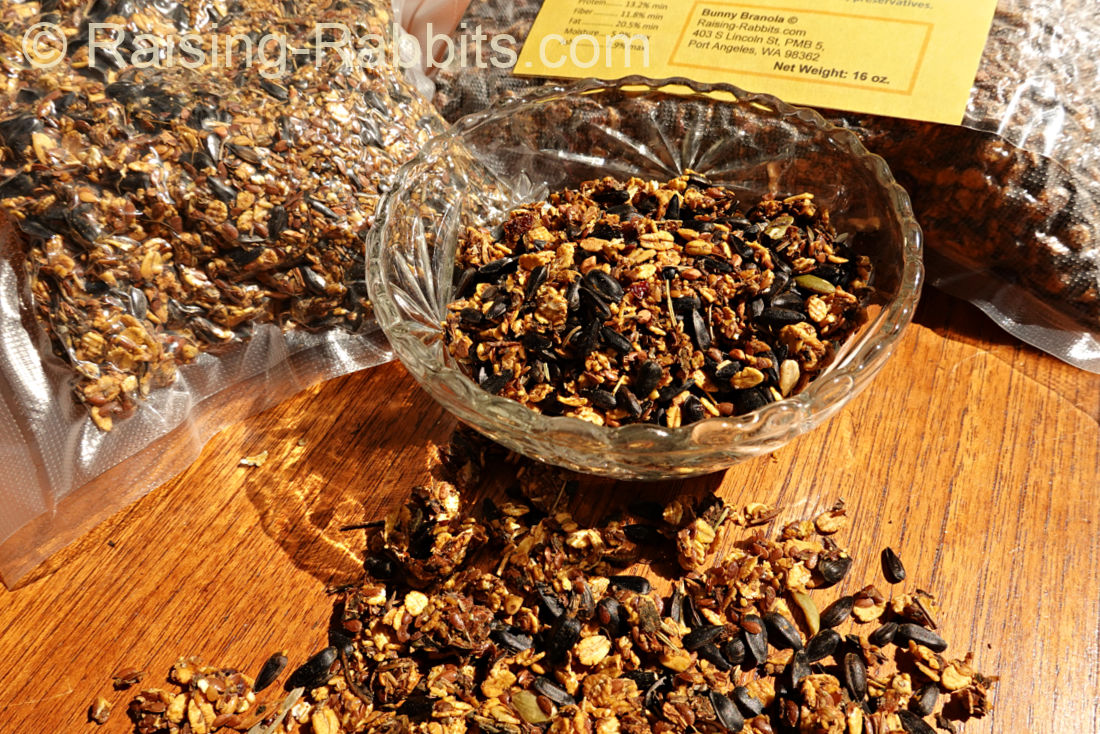
SIX delicious flavors - Sample packs available.
Yes! I want more info!
Yes, Buy Bunny Branola Now!
Raising Rabbits Sweatshirts, T-shirts, and Hoodies!
 |
 |
 |
Now offering classy, unisex Raising Rabbits sweatshirts and hoodies.
Available in a large assortment of colors! (We have unisex T-shirts too.)
Find these gorgeous garments in the Bunny Bazaar!
Order your own today - They make great gifts too!!
Featured Rabbitries:
Click the Rabbitry Name Links:
Canada, Quebec
MapleRidge Stables Rabbitry
Himalayan Rabbits
Arizona
Hostile Hare
Chinchillas, Cages
Illinois
Open Doors Rabbitry
Lionheads, New Zealands
Kentucky
Goshen Bunnies
Holland Lop and Mini Plush Lop
Minnesota
Lops of Love Rabbitry
Closed for Christmas vacation
New Jersey
Belle's Bunny Boutique
Holland Lops & Mini Lion Lops
North Carolina
What The Fluffle Rabbitry
New Zealands, Champagnes
Breadbox Rabbitry
Netherland Dwarfs
Pennsylvania
Happily Ever After
Mini Plush Lops, Holland Lops,
Netherland Dwarf, Lionhead,
Mini Plush Lop, & Mini Rex
Bunnies by Emma and Ellie
Holland Lop, Mini Lop, Mini Plush Lop,
Mini Rex/Holland Lop Mix
South Carolina
Jubilee Farms
Holland Lops
Subscribe to Rabbit Rhythms,
our e-newsletter !
Get rabbit news, husbandry and health tips mostly every month. It's easy - we only need your email address, then hit the 'subscribe' button. Enjoy!
Recent Articles


-
All rabbit breeds recognized in USA by American Rabbit Breeders Assoc.
Jan 02, 26 06:49 PM
 List of all rabbit breeds recognized by ARBA, along with weights, brief descriptions and link to national rabbit breed club if available
 -
About Ordering Raw Rabbit: Feeding Raw Can Be Easy
Dec 10, 25 05:10 PM
 About ordering raw rabbit: All the details and your questions answered about easily purchasing frozen raw rabbit from Raising-Rabbits.com for your dogs/cats.
 -
Autumn Rabbit Pictures: Autumn-Themed Rabbit Photos
Aug 25, 25 04:14 PM
 Autumn Rabbit Pictures is a delightful collection of bunny photos in various fall themes, including story lines and cute quips..


Raising-Rabbits: Home of
The Rabbit Raising Problem Solver
$22.62 - includes
- 10% off your autographed copy of Rabbit Raising Problem Solver
- All packaging, handling, and Media Mail postage costs (WA residents are subject to sales tax)
- Applies to US addresses - (sadly, Media Mail is not offered for international shipping, not even for really awesome books)
- (International shipping is available, of course, but it's out of our control how much they charge for shipping. Send us your country, city, and area code to obtain a shipping quote.)
* Affiliate Links*
As an affiliate of several companies, including Amazon.com, we earn from qualifying purchases. Your purchases from these affiliates come at no extra cost to you.

New! Comments
Have your say about what you just read! Leave me a comment in the box below.