French Angora Rabbits
French Angora Rabbits. All about the French Angora, plus additional angora-related, wool and spinning info.
The Angora Rabbit has been domesticated for their wool for over 2000 years. See Angora Rabbits for the history of the angora rabbit, as best as can be determined.
The use of French Angoras for wool production in France dates to as early as 1845 in the region of Saint Innocent in Savoy, France. A gentleman named Monsieur Lard developed a large angora herd that provided work for many in St. Innocent. But additionally, he and his wife made it possible for others to start their own angora enterprises.
If you would like to learn more about other Angora breeds, or just other breeds in general, check out our ebook: Domestic Rabbit Breeds.
Interested in Other Rabbit Breeds?
-- Are you trying to decide which breed is best for you?
-- Do you see a bunny available, but haven't heard of that kind before?
-- Are you curious about the different types of rabbits?
We have an e-book for that! It's titled Domestic Rabbit Breeds. Find it, and descriptions of our other e-books, at World of Raising Rabbits.
Purchase Domestic Rabbit Breeds here!
Mr. Lard and his wife frequently gave to the village women and to the poor several pregnant rabbits. They paid by returning half the offspring at 12 - 16 weeks of age. The villagers cared for their own rabbits and reaped the benefits. They sheared the wool, spun the yarn, made garments according to their skills, and sold their products, whether wool, yarn or garment. It was a win win win situation, enabling the enterprising to support the family and the poor to rise out of abject poverty.
No wonder France quickly became the global leader of raw angora wool production, holding this distinction until 1965.
French Angora rabbits most resemble the angoras of centuries past. This is because they have fur, not wool, on their face, ears and feet. (Compare them to the English Angoras that are wooly everywhere except, possibly, on the tips of their noses.)
This is not to say that improvements in wool quality and quantity have not been made. To the contrary, breeders have indeed made great improvements in all aspects of French Angora rabbits. The wool of a rabbit in full show coat has far more height, density and bulk than did angoras of even 80 years ago.
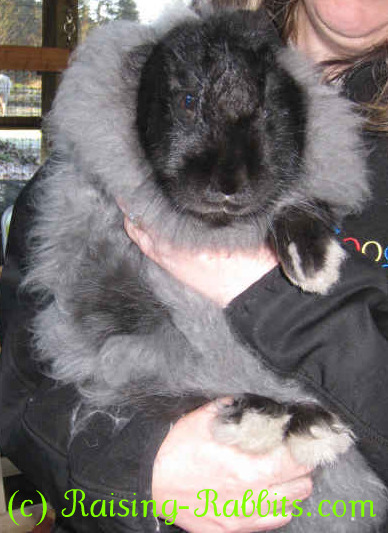
French Angoras as recognized by the ARBA
weigh between 7 1/2 and 10 1/2 pounds.
The ARBA Standard of Perfection awards 35 points to the body, 55 points to wool, and 10 points to color and condition, for a total of 100 points. The body type is more commercial than is the English Angora.
They can be shown in two varieties of white, plus nearly every color possible, including the brokens of these colors:
- Pointed in black, blue, chocolate and lilac
- Red-Eyed-White (REW)Blue-Eyed-White (BEW)
- Chinchilla (black), chocolate chin, lilac chin, and squirrel (blue chin)
- Chestnut (black agouti), chocolate agouti, copper, lynx, opal
- Self (same color all over) in black, blue, chocolate and lilac
- Shaded - Pearl, Sable, Seal, Smoke Pearl
- Tortoiseshell (black), blue tort, chocolate tort, lilac tort
- Ticked - Steel (black), blue, chocolate, and lilac steels
- Wide-banded - Cream, Fawn, Red
This makes 66 total allowable varieties in the USA. English, French and Satin Angoras are accepted in all of these varieties.
French Angora rabbits are a dual-purpose breed. They have oval-shaped, commercial bodies that provide plenty of meat, plus the wool for fiber. The wool, with its coarse guard hairs protruding beyond the crimped underwool, is usually low-maintenance, requiring minimal grooming.
Expect to find no wool on face, ears (other than minor tufting on some), and feet, up to the ankle joint. Their toenails should match if you plan to show the animal.
National club representing French Angoras: www.nationalangorarabbitbreeders.com/
Good nutrition is key to wool production. Our delicious supplement, Bunny Branola, has all natural ingredients to help your rabbit make luxurious angora.
Bunny Branola
The Ultimate Rabbit Conditioning Supplement
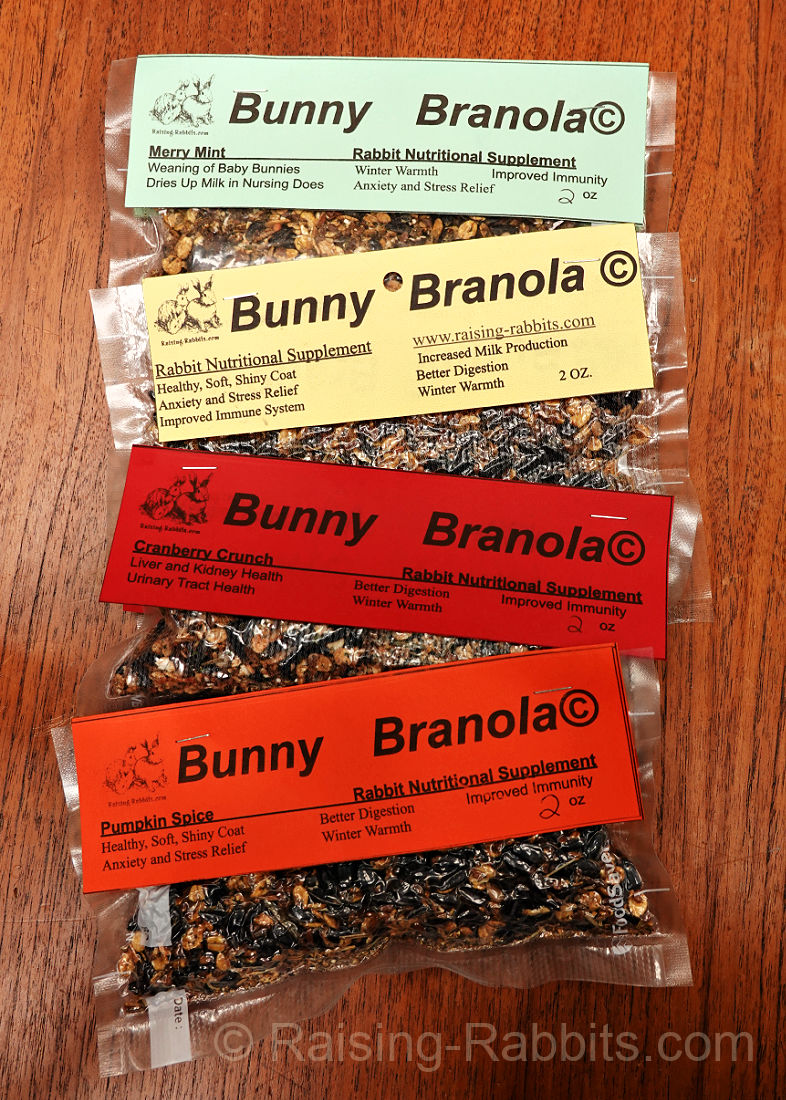 |
Bunny Branola is the ultimate rabbit conditioning supplement. Our specially formulated treat is all natural ingredients from Washington state. No dyes, preservitives, empty fillers, or other chemicals, just pure goodness. Bunny Branola is available in 4 delicious flavors year round: Original Classic (General Health) If you want to find out more about Bunny Branola, including the list of all natural ingredients click HERE. If you are ready to buy now, we have several sizes, just click the one you want. All prices include shipping. Sample: 2 oz - $7 |
French Angora Rabbit Wool
The wool on French Angoras has a higher percentage of guard hair to underwool than the English Angora. The guard hairs protrude above the underwool, which is heavily crimped. Expected wool length is 3 ½ to 4 ½ inches, though it can grow longer if not harvested.
The extra guard hairs simplify the care and grooming, as the coat is far less prone to matting or felting on the rabbit. The fiber qualities are excellent for handspinning. It spins easily, and the yarn is fluffy.
French Angoras are fairly low maintenance. Nevertheless, if you’re utilizing the fiber, it is best if you do minor grooming regularly in order to ensure no mats, webs or felting.
- A maintenance schedule would include using a heavy blower to blow through the coat once or twice a week as long as the rabbit is in prime wool
- The rabbits should normally be sheared 2-3 times a year.
- Regular grooming keeps the rabbits beautiful,
maintaining the good personalities and gentleness of French Angora rabbits.
Angora wool is 7 times warmer than wool from sheep.
- It is a natural animal fiber
- It is clean, coming directly from the rabbit
- It does not require washing, picking, combing or carding
- It is luxurious
- It is very durable
- It is hand-washable
- It is non-allergenic, does not irritate the skin
- It is easy to dye
- It blends extremely well with other fibers.
This list comes from www.joyofhandspinning.com, where you can find extensive information on handspinning angora and many other types of wool.
Check out this great video of spinning directly off of the bunny!
Is This Your Rabbit Breed?
Do you have a great story or experience with this breed of rabbits? Feel free to share it!
And while you're at it, you can include up to four photos.
Here's a quick video on grooming a french angora
rabbit, and at the same time obtaining wool for spinning:
References:
http://www.nationalangorarabbitbreeders.com/
http://www.planet-pets.com/rabtfrenchangora.htm
https://www.joyofhandspinning.com/angora-care.shtml
http://en.wikipedia.org/wiki/Angora_rabbit
Domestic Rabbits and Their Histories, by Bob D. Whitman
Double-Value Guarantee
Our policy is to always OVER-deliver
on value,
which is why your purchase is fully covered by our
Double-Value
Guarantee.
Go ahead - take any of our e-books for a test drive. Peruse our detailed informational and educational e-books. Examine our plans for building rabbit cages, runs, or metal or PVC hutch frames. Check out the Rabbit Husbandry info e-books.
If you aren't completely satisfied that your e-book purchase is worth at least double, triple or even quadruple the price you paid, just drop us a note within 45 days, and we'll refund you the entire cost. That's our Double-Value Guarantee.
Note: When you purchase your
e-books, they will be in PDF format, so you can download them to any device that
supports PDF format. We advise making a back-up copy to a drive or cloud
account. If the books are lost, you can also purchase another copy from Raising-Rabbits.
* Affiliate Links*
As an affiliate of several companies, including Amazon.com, we earn from qualifying purchases. Your purchases from these affiliates come at no extra cost to you.
Bunny Bazaar!
Online Shopping Mall by Raising-Rabbits!
One-Stop Shop for Rabbit Swag for both Rabbits and Humans
Bunny Branola:
Immune-Boosting Rabbit Nutritional Supplement and Treat!
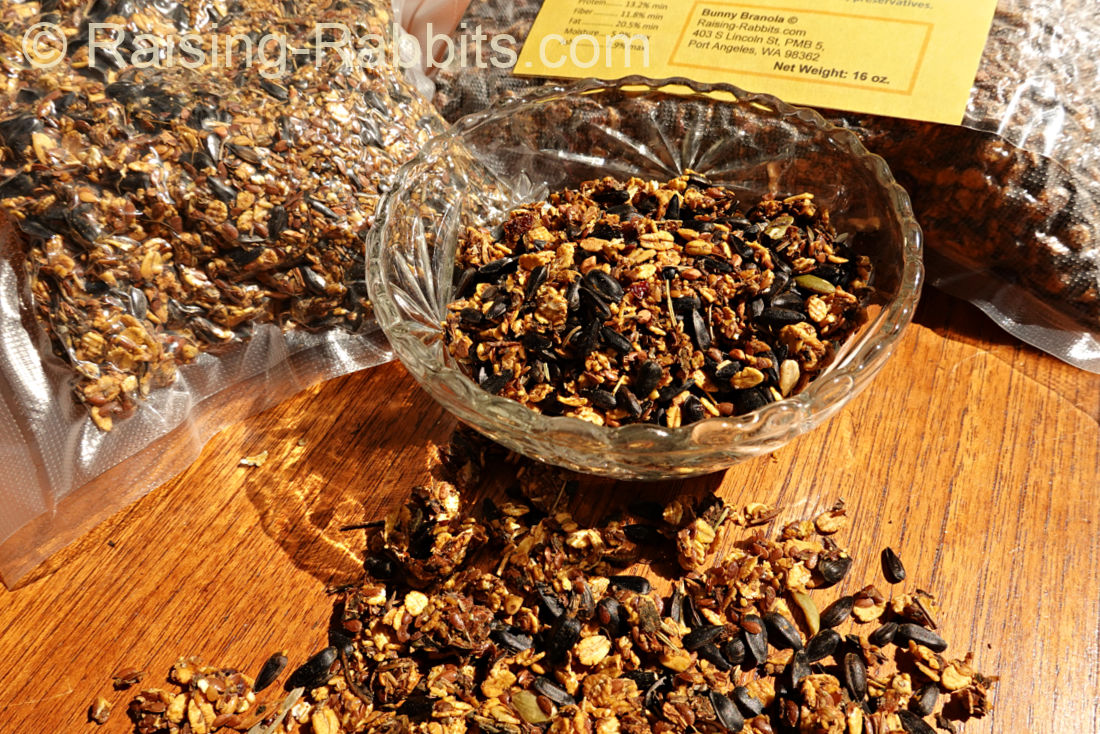
SIX delicious flavors - Sample packs available.
Yes! I want more info!
Yes, Buy Bunny Branola Now!
Raising Rabbits Sweatshirts, T-shirts, and Hoodies!
 |
 |
 |
Now offering classy, unisex Raising Rabbits sweatshirts and hoodies.
Available in a large assortment of colors! (We have unisex T-shirts too.)
Find these gorgeous garments in the Bunny Bazaar!
Order your own today - They make great gifts too!!
National Rabbit Associations
American Rabbit Breeders Association (ARBA) is the national club for breeders of both rabbits and cavies (guinea pigs) in the United States. Anyone can join for a modest fee, and get wonderful support for their rabbit raising efforts.

The British Rabbit Council - Official Website of the British Rabbit Council, whose mission is to support the interests of all British rabbit breeders, including exhibition, breeding, and welfare.

Rabbit Council of NZ (Inc.) - The New Zealand Rabbit Council provides a comprehensive website about Rabbit related issues and events within New Zealand and overseas.
Australian National Rabbit Council Inc. - "An Australian Rabbit Club for Australian Rabbit Owners." It was established in order to "coordinate and promote Rabbit Clubs and interest groups throughout Australia."
Featured Rabbitries:
Click the Rabbitry Name Links:
Canada, Quebec
MapleRidge Stables Rabbitry
Himalayan Rabbits
Arizona
Hostile Hare
Chinchillas, Cages
Illinois
Open Doors Rabbitry
Lionheads, New Zealands
Kentucky
Goshen Bunnies
Holland Lop and Mini Plush Lop
Minnesota
Lops of Love Rabbitry
Closed for Christmas vacation
New Jersey
Belle's Bunny Boutique
Holland Lops & Mini Lion Lops
North Carolina
What The Fluffle Rabbitry
New Zealands, Champagnes
Breadbox Rabbitry
Netherland Dwarfs
Pennsylvania
Happily Ever After
Mini Plush Lops, Holland Lops,
Netherland Dwarf, Lionhead,
Mini Plush Lop, & Mini Rex
Bunnies by Emma and Ellie
Holland Lop, Mini Lop, Mini Plush Lop,
Mini Rex/Holland Lop Mix
South Carolina
Jubilee Farms
Holland Lops
Subscribe to Rabbit Rhythms,
our e-newsletter !
Get rabbit news, husbandry and health tips mostly every month. It's easy - we only need your email address, then hit the 'subscribe' button. Enjoy!
Recent Articles


-
Pet Rabbits: Confident Care, Feeding, and Enjoyment
Feb 14, 26 05:46 PM
 Pet rabbits: Care and feeding, including a critical-needs list of requirements. Confidently care for your bunnies with this list of rabbit care tips
 -
All rabbit breeds recognized in USA by American Rabbit Breeders Assoc.
Jan 02, 26 06:49 PM
 List of all rabbit breeds recognized by ARBA, along with weights, brief descriptions and link to national rabbit breed club if available
 -
About Ordering Raw Rabbit: Feeding Raw Can Be Easy
Dec 10, 25 05:10 PM
 About ordering raw rabbit: All the details and your questions answered about easily purchasing frozen raw rabbit from Raising-Rabbits.com for your dogs/cats.

Raising-Rabbits: Home of
The Rabbit Raising Problem Solver
$22.62 - includes
- 10% off your autographed copy of Rabbit Raising Problem Solver
- All packaging, handling, and Media Mail postage costs (WA residents are subject to sales tax)
- Applies to US addresses - (sadly, Media Mail is not offered for international shipping, not even for really awesome books)
- (International shipping is available, of course, but it's out of our control how much they charge for shipping. Send us your country, city, and area code to obtain a shipping quote.)
* Affiliate Links*
As an affiliate of several companies, including Amazon.com, we earn from qualifying purchases. Your purchases from these affiliates come at no extra cost to you.