Taking Care of Baby Rabbits
Sometimes the Doe Needs a Little Help...
The mother rabbit (doe) knows best about taking care of baby rabbits. Most does can build their nest, kindle their babies, and feed and care for them without a single hitch.
But every once in a while, for whatever reason, a doe might need a helping hand just to get her onto the right foot, so to speak. For example...
Last night I entered the barn to feed the animals. Four rabbits were due to have their litters, but I didn’t expect any activity until very late in the evening.
Madrona, a chinchilla rex doe, however, had pulled fur from her tummy and dewlap, and had scattered it all over the cage. She had half-lined the rabbit nest box, and had two more piles of fur outside the box, one pile in front, and another on the side. It almost looked like she was trying to line the entire cage!
A little more checking revealed six lovely newborn baby rabbits huddled just inside the nest box, with nary a scrap of fur covering them. Given that it was 39 degrees and dropping, I breathed a prayer of gratitude that this doe had given birth early in the evening before I had fed the rabbits and then disappeared into the house for the evening.
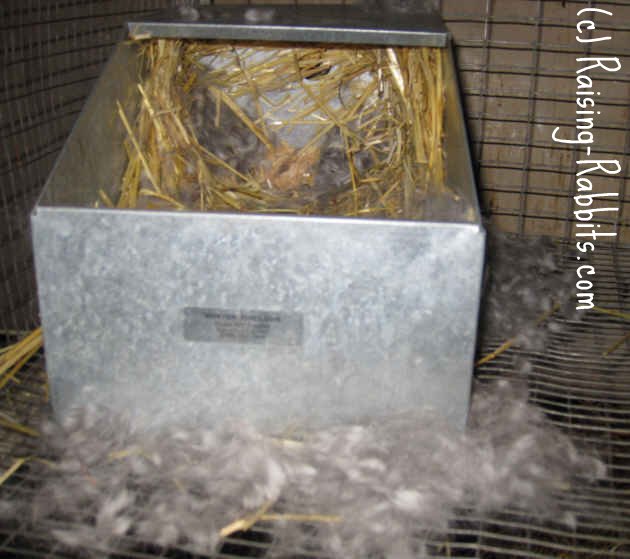
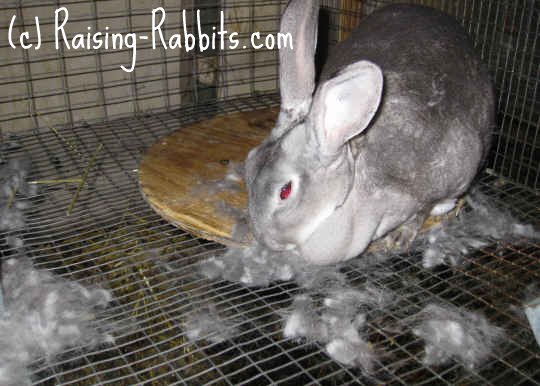
Nesting Box Materials: Pine Shavings, Hay, Straw
The kits were still very warm - I had stumbled upon their
birth within minutes of kindling. Any
other scenario could easily have ended in kits frozen to death.
The poor confused doe was trying very hard to take good care of her baby rabbits, but it was clearly time to intervene on behalf of the little ones.
I pulled out the rabbit nest box, placing each of the kits deep into the burrow capably hollowed out and lined by the doe.
There was a lot of fur on the cage floor! Gathering together most of it, I placed it in the nest box, covering the kits with a thick layer of her fur. (I could have pulled more from her tummy if I had needed to.)
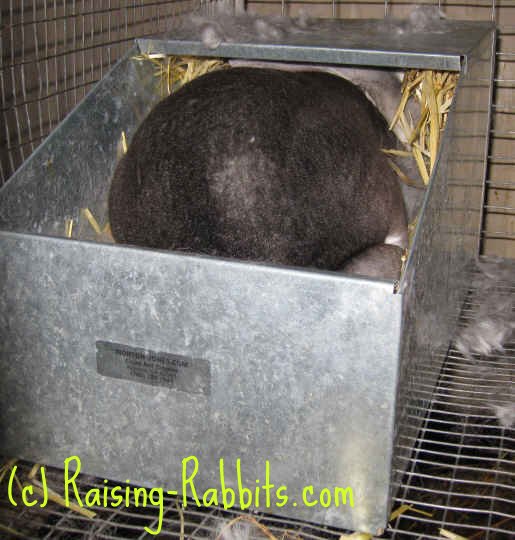
No sooner had I placed the nest box back inside the doe’s cage, than she hopped into the box. All that could be seen for a good 15 minutes was the hind end of her rump, as I assume she was feeding her babies. This was the point at which I turned away and finished feeding the rabbits.
A few days later I was back in the barn.
Madrona, the chinchilla doe, was sitting placidly in her nest. Her kits were warm and snuggly, with round full tummies. Yes, she was now taking care of her baby rabbits perfectly. She let me pet her appreciatively.
Very rarely will a doe completely lose touch with her instincts, or reject her babies. This sometimes happens if the doe is severely frightened while in the act of kindling. She might even destroy her kits if, say, a raccoon or a rat were to nose around the barn or threaten the cage. (I have 2 barn cats, but they don't bother the rabbits, and the rabbits are accustomed to their presence.)
Are you sure your doe is rejecting her kits, or not feeding them enough? Our page on feeding wild rabbits is applicable to very young orphaned domestic rabbits as well. You'll also find help at Feeding Baby Rabbits.
Otherwise, do your best to help the doe only if it
is apparent she needs the help.
Most of the time, the doe is better than humans at taking care of baby
rabbits.
A tablespoon of black oil sunflower seeds enhances the doe's condition and lactation.
Bene-Bac helps to safeguard kits against dangerous diarrhea.
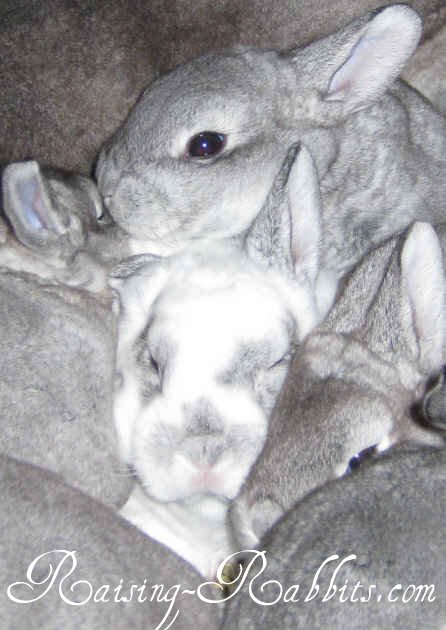
Taking care of baby rabbits is so rewarding!
Madrona did herself proud. She just needed a little help at the beginning.
Here is her litter, fresh out of the nest box 2 1/2 weeks later and doing terrific.
They'll be ready to wean in another month.
Click here for more info on taking care of baby rabbits immediately after birth
Double-Value Guarantee
Our policy is to always OVER-deliver
on value,
which is why your purchase is fully covered by our
Double-Value
Guarantee.
Go ahead - take any of our e-books for a test drive. Peruse our detailed informational and educational e-books. Examine our plans for building rabbit cages, runs, or metal or PVC hutch frames. Check out the Rabbit Husbandry info e-books.
If you aren't completely satisfied that your e-book purchase is worth at least double, triple or even quadruple the price you paid, just drop us a note within 45 days, and we'll refund you the entire cost. That's our Double-Value Guarantee.
Note: When you purchase your
e-books, they will be in PDF format, so you can download them to any device that
supports PDF format. We advise making a back-up copy to a drive or cloud
account. If the books are lost, you can also purchase another copy from Raising-Rabbits.
* Affiliate Links*
As an affiliate of several companies, including Amazon.com, we earn from qualifying purchases. Your purchases from these affiliates come at no extra cost to you.
Bunny Bazaar!
Online Shopping Mall by Raising-Rabbits!
One-Stop Shop for Rabbit Swag for both Buns and Humans
Bunny Branola!
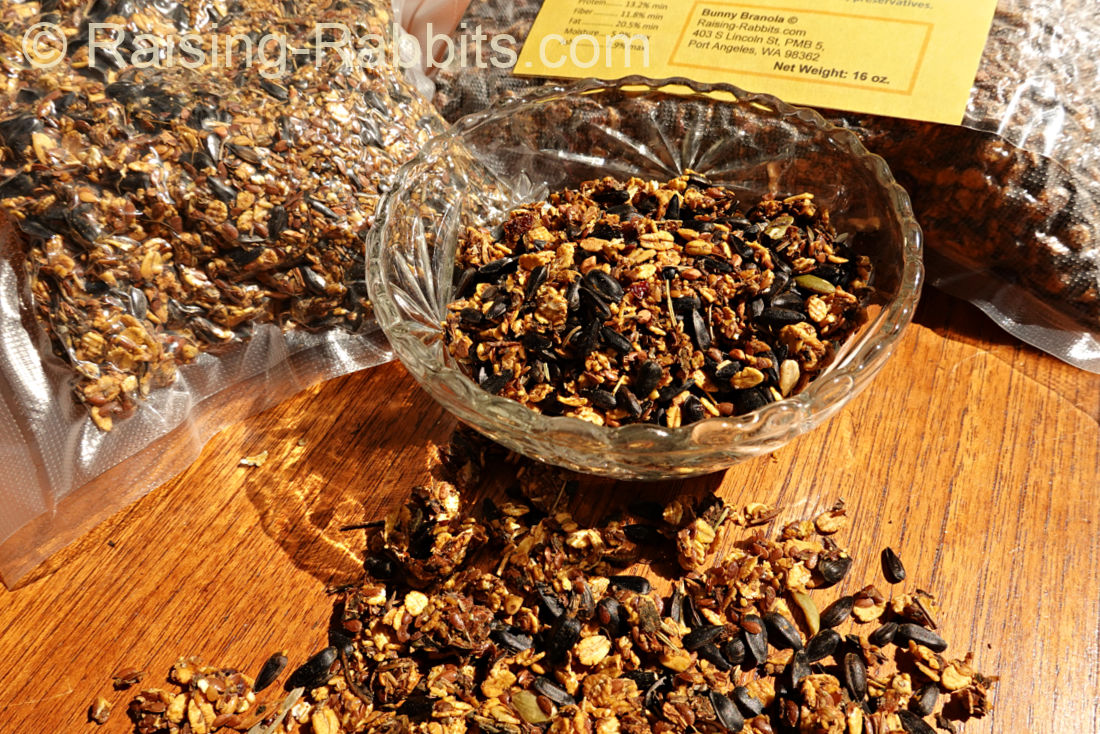
The Ultimate
Rabbit Nutritional Supplement and Treat!
4 delicious flavors! Sample packs available!
Yes! I want more info!
Yes, Buy Bunny Branola Now!
Look What's NEW!!
Our very own classy
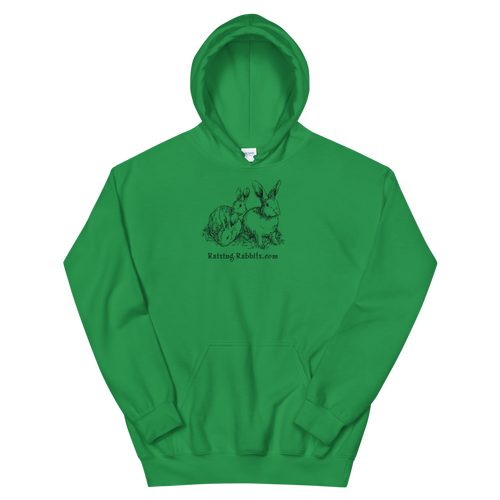
Raising Rabbits Sweatshirts, T-shirts, and Hoodies!
 |
 |
 |
.
We're now offering classy, unisex
Raising Rabbits
sweatshirts and hoodies,
Available in a great assortment of colors!
(We have unisex T-shirts too.)
Check out the Bunny Bazaar for our gorgeous
garments!
Order your own today!
They make great gifts too!!
Featured Rabbitries:
Click the Rabbitry Name Links:
Canada, Quebec
MapleRidge Stables Rabbitry
Himalayan Rabbits
Arizona
Hostile Hare
Chinchillas, Cages
Illinois
Open Doors Rabbitry
Lionheads, New Zealands
Kentucky
Goshen Bunnies
Holland Lop and Mini Plush Lop
New Jersey
Go Bunny Treats
All Natural Rabbit Treats
Mini Plush Lop Bunnies
All Natural Rabbit Treats
Belle's Bunny Boutique
Holland Lops & Mini Lion Lops
North Carolina
What The Fluffle Rabbitry
New Zealands, Champagnes
Breadbox Rabbitry
Netherland Dwarfs
The Farm at Fort Mill
Holland Lops
(Right across the South Carolina
border at Charlotte)
Pennsylvania
Happily Ever After
Mini Plush Lops, Holland Lops,
Netherland Dwarf, Lionhead,
Mini Plush Lop, & Mini Rex
Bunnies by Emma and Ellie
Holland Lop, Mini Lop,
Mini Plush Lop,
Mini Rex/Holland Lop Mix
Rhode Island
Shepherds Purse Rabbitry
Holland Lops
South Carolina
Jubilee Farms
Holland Lops
Washington
Cotton Candie Tails
Lionheads, Vienna-Marked
Subscribe to Rabbit Rhythms,
our e-newsletter !
Get rabbit news, husbandry and health tips mostly every month. It's easy - we only need your email address, then hit the 'subscribe' button. Enjoy!
Recent Articles


-
Raw Rabbit: Order raw frozen rabbit for pets
Mar 25, 24 07:45 PM
 Raw rabbit. Convenient online ordering of raw frozen rabbit as whole prey, partially processed, or ground, for feeding pets species-appropriate meals
 -
Farm at Fort Mill
Mar 01, 24 03:22 PM
 Farm at Fort Mill has moved. It is now Jubilee Farms Holland Lops, part of Edgemoor Equestrian, in Edgemoor SC. They offer riding lessons and host events.
 -
Jubilee Farms Holland Lops - Rabbitry in Edgemoor, SC
Feb 26, 24 04:01 PM
Jubilee Farms Holland Lops includes a Rabbitry in Edgemoor, SC. Jubilee Farms also has horses and riding lessons, and hosts events and learning camps.
Raising-Rabbits: Home of
The Rabbit Raising Problem Solver
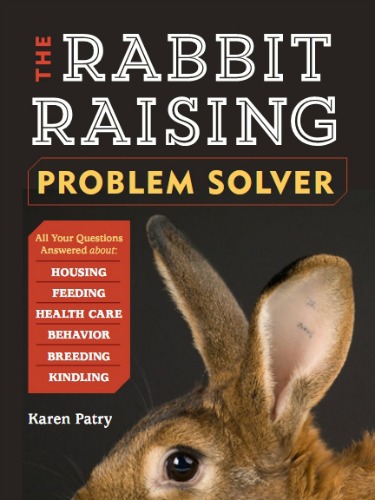
$22.62 - includes
- 10% off your autographed copy of Rabbit Raising Problem Solver
- All packaging, handling, and Media Mail postage costs (WA residents are subject to sales tax)
- Applies to US addresses - (sadly, Media Mail is not offered for international shipping, not even for really awesome books)
- (International shipping is available, of course, but it's out of our control how much they charge for shipping. Send us your country, city, and area code to obtain a shipping quote.)
* Affiliate Links*
As an affiliate of several companies, including Amazon.com, we earn from qualifying purchases. Your purchases from these affiliates come at no extra cost to you.

New! Comments
Have your say about what you just read! Leave me a comment in the box below.