Sexing Rabbits
Sexing Rabbits and sexing baby bunnies. How to tell male
rabbits from female rabbits. It is easy, with our photos of 6 week old kits and
adult rabbits and complete guidelines and tips.
It’s almost a joke - you go to the pet store or rabbit breeder, buy two of the cutest bunnies you ever did see, and the sales clerk assures you they’re both does. He even checks them for you on the spot. Yep, girls.
A couple months later, one of the rabbits is pregnant.
...Ooops!

Sexing rabbits can be subject to operator error. The likely
cause of the misidentification of a rabbit’s gender is simply not knowing
exactly how to sex a rabbit.
It is not hard to tell male from female, but it is easy to make a mistake if you don't examine the bunnies carefully. This is because in little bucklings,
--Their equipment hasn’t descended, and
--Without sufficient pressure, the penile sheath does not protrude enough for you to tell the difference between buck and doe.
If you don’t apply enough pressure on the vent area for
fear of hurting the bunny, nothing will protrude at all. That is where sexing rabbits can get tricky,
but keep reading - we'll show you exactly how to determine the gender of a
rabbit, whether a bunny or an adult rabbit. And we have included some great
pictures to help you 'see' what to do.
How to Tell the Gender of a Rabbit
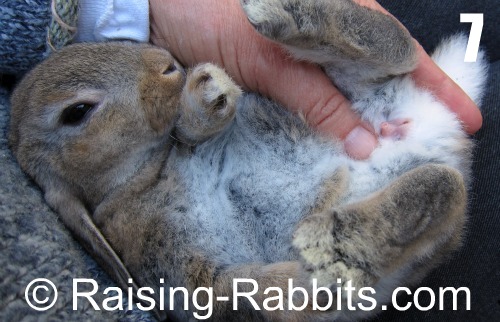
Place the kit in your lap bottom side up. I place the head against my tummy and the tail towards my knees (see picture #7 below for the big view).
This is what you’ll see...
A six-week-old buck is pictured in #1. A six-week-old doe is pictured in #2.
There’s not much difference in these pictures!
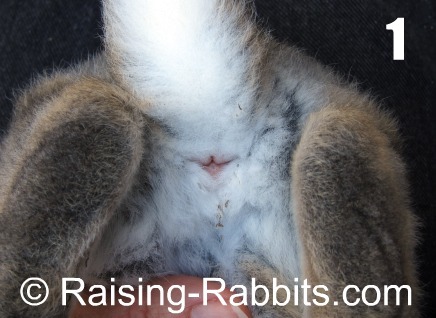
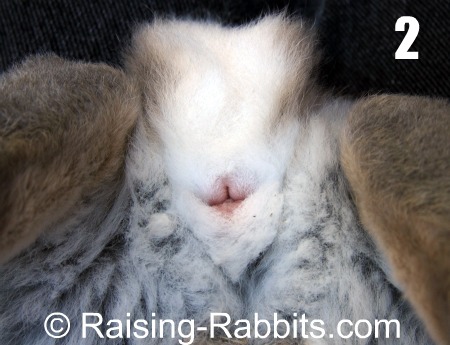
This is because the anus and the privates are normally scrunched together, like two doorways facing each other in a short hallway.
With the kits simply flipped over, you don’t see much of anything.
In these views, the vertical slit on the tail side is part of the anus, and the opening for the privates is tucked into the crevice and barely visible.
Testimonial
Benjamin Smith, Lead Instructional Designer at Bendigo TAFE and Kangan Institute, in Melbourne, Australia, requested and was granted permission to use these Raising-Rabbits images to instruct students studying animal care and management about sexing rabbits. Thank you, Professor Smith! (February 2023)
So here's what you do. Pinch
the tail between the first two fingers, and place the thumb on the fur in the
vent area.
Pull on the tail gently but firmly, and press downward on the vent with the thumb.
This will open up the works so you can tell what is what.
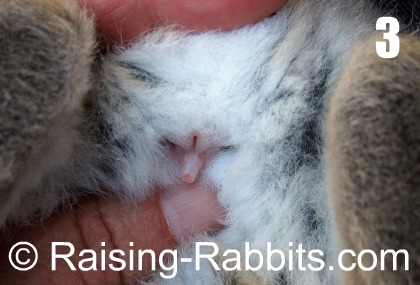
In picture #3, you can see that a tubular structure is clearly protruding, and it has a circle opening. Yep, this is a little buck. Circle openings that protrude a lot belong to bucks.
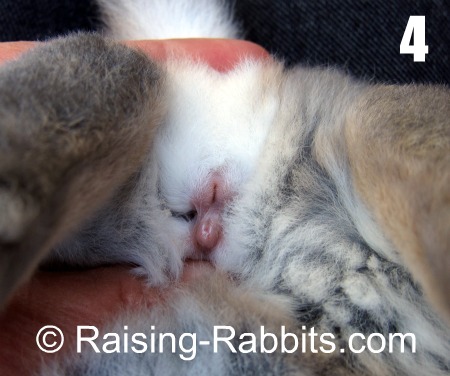
Picture #4 shows a little doe. With a bit of firm pressure on the vent, you can see an opening that stretches to a slit without hardly protruding at all, even if you push a little harder with your thumb. Linear openings that don't protrude hardly at all belong to does.
Common online descriptions include the term "burrito" for bucklings, and "taco" for doelings. Now you can see why!
Here's the Key to Sexing Rabbits Correctly
Here is the simple key to getting it right:
Push with enough pressure that little boy protrusions do not stay hidden.
Do not be afraid to apply firm pressure, without pushing clear to the backbone, of course.
Here are a couple close-up pictures:
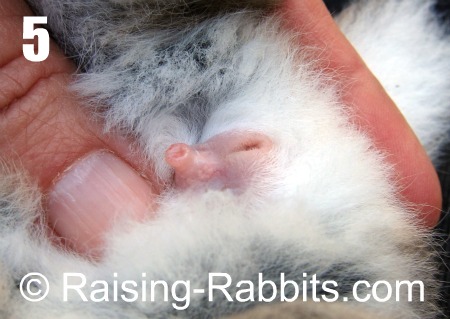
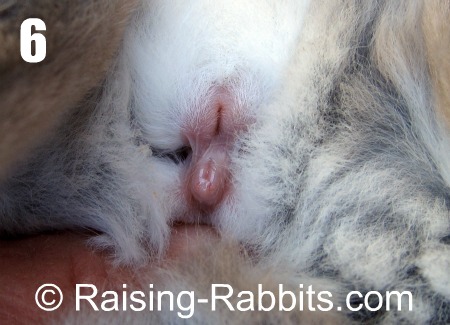
Here’s how I hold them - bottoms-up in my lap, head against the stomach and hind end towards the knees. In photo #5 above, you see that the tail is clasped between two fingers, and the thumb is pushing down fairly firmly on the vent area.
Photo #7 below shows you the entire bunny in my lap. There is more than one way to hold the bunny, but this is an easy way...
Where can I find top quality rabbit cages that are great for rabbit feet?

From Raising-Rabbits, of course!
Raising-Rabbits has partnered with Hostile Hare to bring you cages that exceed our rigorous rabbit housing standards.
We do not manufacture cages, but we sure recognize a well-built, predator-proof, baby-safe, bunny-feet-safe cage when we see it! We think Hostile Hare cages will serve you well for years.
Explore the choices by clicking the logo or this link!
Sexing Rabbits when Adults
The gender of adult rabbits is very easy to identify.
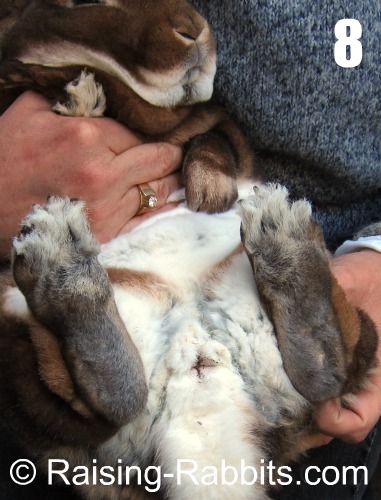
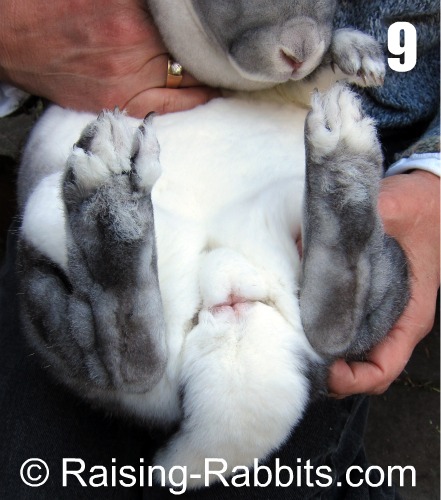
A castor rex buck is pictured in #8. A chinchilla rex doe is pictured in #9.
Again, at first glance, their hind ends don’t look all that different, because the openings are still facing each other.
But on the adult buck, you can now see two long grayish areas on either side of the vent. These are thinly furred scrotal sacs - a dead giveaway to his buckhood.
Applying the same techniques as we did to the bunnies, grasp the tail between your first two fingers and apply gentle but firm pressure to the vent with the thumb.
Here’s what you’ll see:
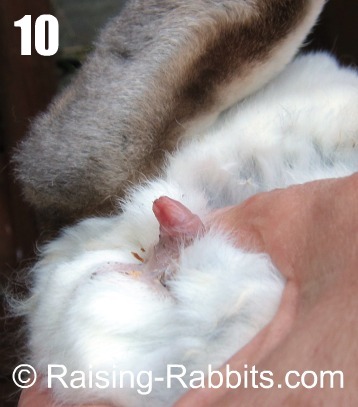
Picture #10 is a buck.
If you happened to miss the scrotal sacs, a buck will offer an obvious protrusion from the vent.
It doesn’t take much pressure at all to reveal the privates.
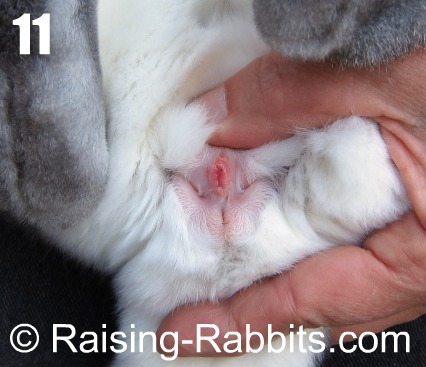
Picture #11 is a doe.
With the doe, nothing actually protrudes. As you apply firm pressure, you’ll discover the same slit you found on the bunny, and it will be easier to reveal it.
If it looks like there’s a bit of a protrusion, it is only because you are pressing downward on the vent.
For more info about sexing rabbit kits, and about the weaning process see Rabbit Raising Problem Solver, pages 148-149, and Chapter 9, Managing the Nursery (starting on page 190),
Consider becoming a member of the American Rabbit Breeders Association

Double-Value Guarantee
Our policy is to always OVER-deliver
on value,
which is why your purchase is fully covered by our
Double-Value
Guarantee.
Go ahead - take any of our e-books for a test drive. Peruse our detailed informational and educational e-books. Examine our plans for building rabbit cages, runs, or metal or PVC hutch frames. Check out the Rabbit Husbandry info e-books.
If you aren't completely satisfied that your e-book purchase is worth at least double, triple or even quadruple the price you paid, just drop us a note within 45 days, and we'll refund you the entire cost. That's our Double-Value Guarantee.
Note: When you purchase your
e-books, they will be in PDF format, so you can download them to any device that
supports PDF format. We advise making a back-up copy to a drive or cloud
account. If the books are lost, you can also purchase another copy from Raising-Rabbits.
* Affiliate Links*
As an affiliate of several companies, including Amazon.com, we earn from qualifying purchases. Your purchases from these affiliates come at no extra cost to you.
Bunny Bazaar!
Online Shopping Mall by Raising-Rabbits!
One-Stop Shop for Rabbit Swag for both Rabbits and Humans
Bunny Branola:
Immune-Boosting Rabbit Nutritional Supplement and Treat!
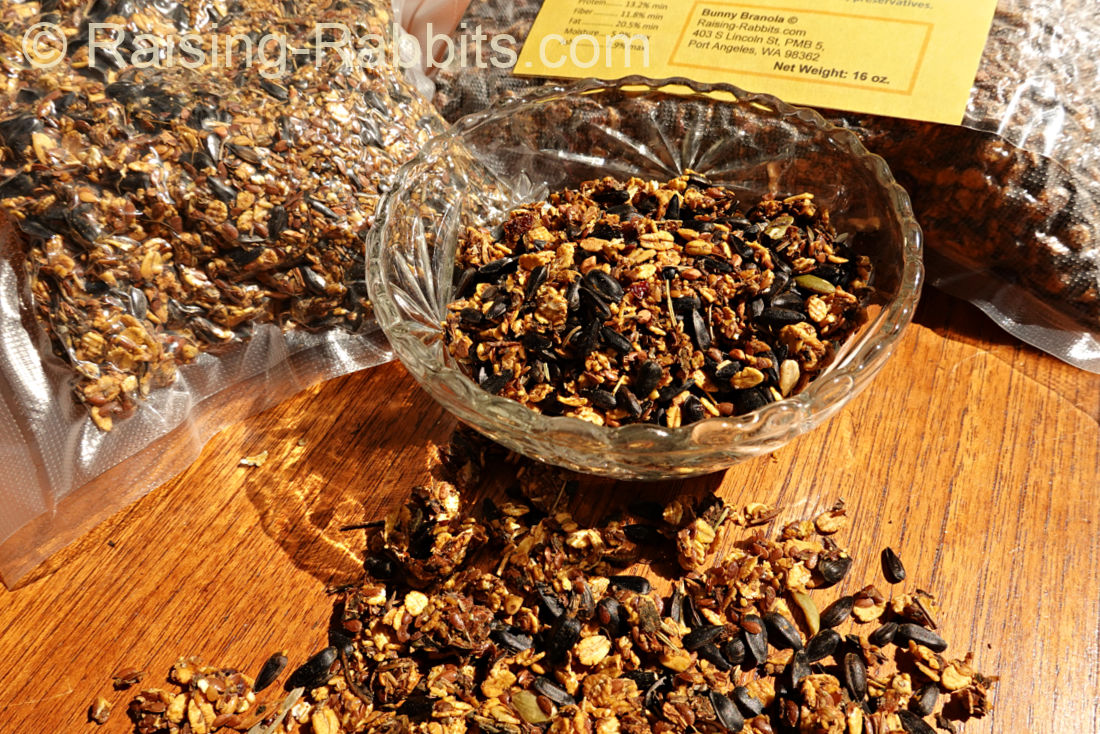
SIX delicious flavors - Sample packs available.
Yes! I want more info!
Yes, Buy Bunny Branola Now!
Raising Rabbits Sweatshirts, T-shirts, and Hoodies!
 |
 |
 |
Now offering classy, unisex Raising Rabbits sweatshirts and hoodies.
Available in a large assortment of colors! (We have unisex T-shirts too.)
Find these gorgeous garments in the Bunny Bazaar!
Order your own today - They make great gifts too!!
Featured Rabbitries:
Click the Rabbitry Name Links:
Canada, Quebec
MapleRidge Stables Rabbitry
Himalayan Rabbits
Arizona
Hostile Hare
Chinchillas, Cages
Illinois
Open Doors Rabbitry
Lionheads, New Zealands
Kentucky
Goshen Bunnies
Holland Lop and Mini Plush Lop
Minnesota
Lops of Love Rabbitry
Holland Lop Rabbits
New Jersey
Belle's Bunny Boutique
Holland Lops & Mini Lion Lops
North Carolina
What The Fluffle Rabbitry
New Zealands, Champagnes
Breadbox Rabbitry
Netherland Dwarfs
Pennsylvania
Happily Ever After
Mini Plush Lops, Holland Lops,
Netherland Dwarf, Lionhead,
Mini Plush Lop, & Mini Rex
Bunnies by Emma and Ellie
Holland Lop, Mini Lop, Mini Plush Lop,
Mini Rex/Holland Lop Mix
South Carolina
Jubilee Farms
Holland Lops
Subscribe to Rabbit Rhythms,
our e-newsletter !
Get rabbit news, husbandry and health tips mostly every month. It's easy - we only need your email address, then hit the 'subscribe' button. Enjoy!
Recent Articles


-
Autumn Rabbit Pictures: Autumn-Themed Rabbit Photos
Aug 25, 25 04:14 PM
 Autumn Rabbit Pictures is a delightful collection of bunny photos in various fall themes, including story lines and cute quips..
 -
Featured Rabbit Breeder Index
Jul 27, 25 01:06 AM
 Our Featured Rabbit Breeder Index lists and links to all featured rabbitries on Raising-Rabbits. These share lots of info and photos of their rabbits for sale.
 -
Rabbit Rhythms November 2024 Newsletter by Raising-Rabbits.
Nov 05, 24 06:28 PM
 Rabbit Rhythms November 2024: This edition of Rabbit Rhythms covers rabbit news for Fall - a new rabbit breed (holicers), a Fall photo album, and more!


Raising-Rabbits: Home of
The Rabbit Raising Problem Solver
$22.62 - includes
- 10% off your autographed copy of Rabbit Raising Problem Solver
- All packaging, handling, and Media Mail postage costs (WA residents are subject to sales tax)
- Applies to US addresses - (sadly, Media Mail is not offered for international shipping, not even for really awesome books)
- (International shipping is available, of course, but it's out of our control how much they charge for shipping. Send us your country, city, and area code to obtain a shipping quote.)
* Affiliate Links*
As an affiliate of several companies, including Amazon.com, we earn from qualifying purchases. Your purchases from these affiliates come at no extra cost to you.

New! Comments
Have your say about what you just read! Leave me a comment in the box below.