Rabbit Stew Recipe
This is the rabbit stew recipe that gives you a second helping from the lapin (rabbit) your family ate yesterday.
In our home, rabbit stew turns out differently every time, and believe me, we eat quite a bit. Whatever vegetables we have on hand may very well go into the pot.
For example, in addition to the veggies suggested below, we’ve added beets, cabbage, and leeks at various times. And each pot of lapin (or lappin - rabbit) stew ends up becoming a hearty meal for the whole family, stretching one rabbit into two meals for a family of four.
Ingredients:
-- Bones and meat scraps from one or two rabbits (leftovers)
-- Filtered water to cover
-- S&P to taste
-- 6 cloves garlic, chopped or crushed
-- 1 med or large onion chopped
-- 2-3 carrots, chopped
-- 3-4 celery stalks, chopped
-- 1 tablespoon poultry seasoning
-- 1 teaspoon basil, freshly crushed in mortar, or, generous fresh basil sprig
-- 1 tablespoon vinegar
2-3 potatoes, chopped (with skins), or:
1
cup barley, OR: 1-2 cups noodles, OR: 2 cups brown rice
Add any combination of the following vegetables when nearly finished:
Frozen peas -- half a small bag
Frozen spinach -- 1 small bag
Frozen mustard or collard greens -- 1 small bag
Any leftover veggies you may have in the frig
Top finished rabbit stew recipe, if desired, with your choice of finely chopped herbs/cheese:
Chopped green onions
Chopped cilantro
Chopped parsley
Shredded cheddar, swiss or parmesan cheese
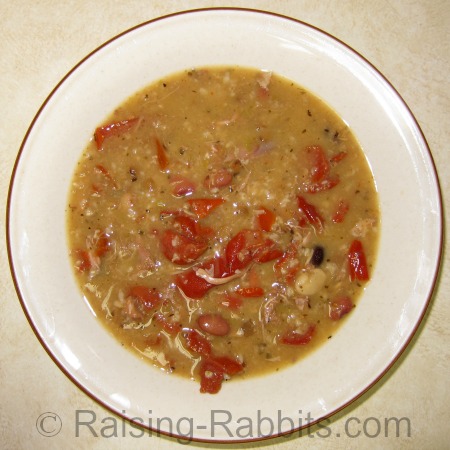
Below: Who says one must follow a recipe to the 't'? This rabbit stew-du-jour contained only beans, oats, rabbit, sun-dried tangy tomatoes, and spices. It was wonderful!
Directions:
After a meal of fried lapin (rabbit), or after crock-potting a stewer rabbit and using the lapin in another recipe (leave a little meat on the bones), gather up the bones and meat scraps and place all in a dutch oven. Cover with filtered water. Add S&P, garlic, onion, carrots, celery, poultry seasoning, basil and vinegar to the pot.
Bring to boil and simmer for several hours, or until bones become soft. (The vinegar helps to leach the minerals out of the bones, yet you'll likely not detect any vinegar flavor.)
Remove pot from heat, and allow to cool.
When cool enough to handle, remove the bones from the pot and discard. To do this, I put a second dutch oven in the sink, place a large colander on top, and pour the lapin broth, bones and veggies into the colander. (Makes the job of getting the bones out easier.)
You can also discard the veggies (my thrifty hub balks at this!) and then re-add various amounts of fresh veggies -- garlic, onion, carrots, celery -- back into the rabbit stew recipe. This will enhance the flavor of the stew as well as add nutrients.
Reheat. Taste; adjust seasoning at will.
Once you’ve brought the pot of rabbit stew to a boil once again, add to the pot your choice of, or combination of, potatoes, barley, noodles or brown rice. (More often than not, we simply omit these ingredients altogether in order to limit our intake of simple carbs.)
Simmer until the newly added fresh veggies and grain are soft, about 30-40 minutes.
When the rabbit stew is just 1-2 minutes from ready, add any assortment of finely chopped herbs and/or cheese to the pot.
Or, you can put these items in bowls and place on the table so family and friends can help themselves.
Bon appetit!
Just so you know:
This rabbit stew recipe supplies you with a good dose of immune-system-strengthening nutrients
You know how meat broth tends to gel in the refrigerator? The reason for this is the presence of glyconutrients -- the immune-system-supercharging ‘alphabet’ whereby your body communicates with each of its parts.
This is hugely important for health. If you don’t eat enough glyconutrients, your immune system has to function with some of its ‘phone lines’ down. Important messages may not get through. You may get sick more often and recuperate more slowly.
Double-Value Guarantee
Our policy is to always OVER-deliver
on value,
which is why your purchase is fully covered by our
Double-Value
Guarantee.
Go ahead - take any of our e-books for a test drive. Peruse our detailed informational and educational e-books. Examine our plans for building rabbit cages, runs, or metal or PVC hutch frames. Check out the Rabbit Husbandry info e-books.
If you aren't completely satisfied that your e-book purchase is worth at least double, triple or even quadruple the price you paid, just drop us a note within 45 days, and we'll refund you the entire cost. That's our Double-Value Guarantee.
Note: When you purchase your
e-books, they will be in PDF format, so you can download them to any device that
supports PDF format. We advise making a back-up copy to a drive or cloud
account. If the books are lost, you can also purchase another copy from Raising-Rabbits.
* Affiliate Links*
As an affiliate of several companies, including Amazon.com, we earn from qualifying purchases. Your purchases from these affiliates come at no extra cost to you.
Bunny Bazaar!
Online Shopping Mall by Raising-Rabbits!
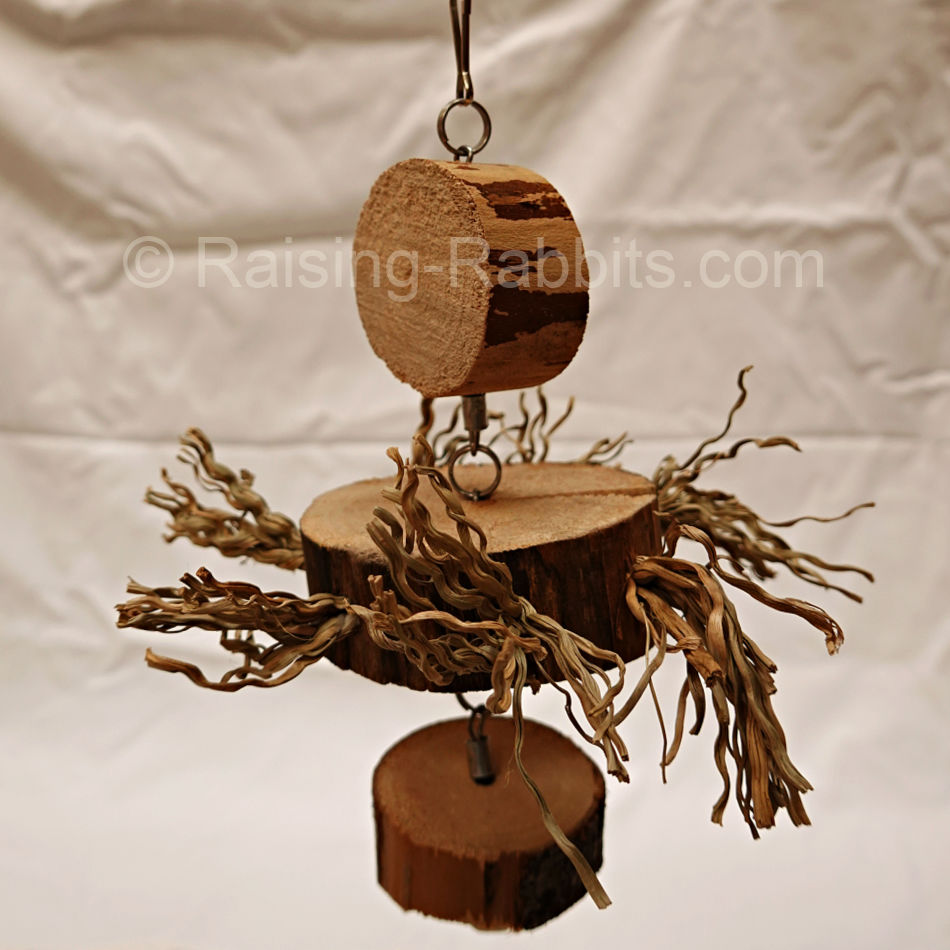
One-Stop Shop for Rabbit Swag for both Buns and Humans
Bunny Branola!
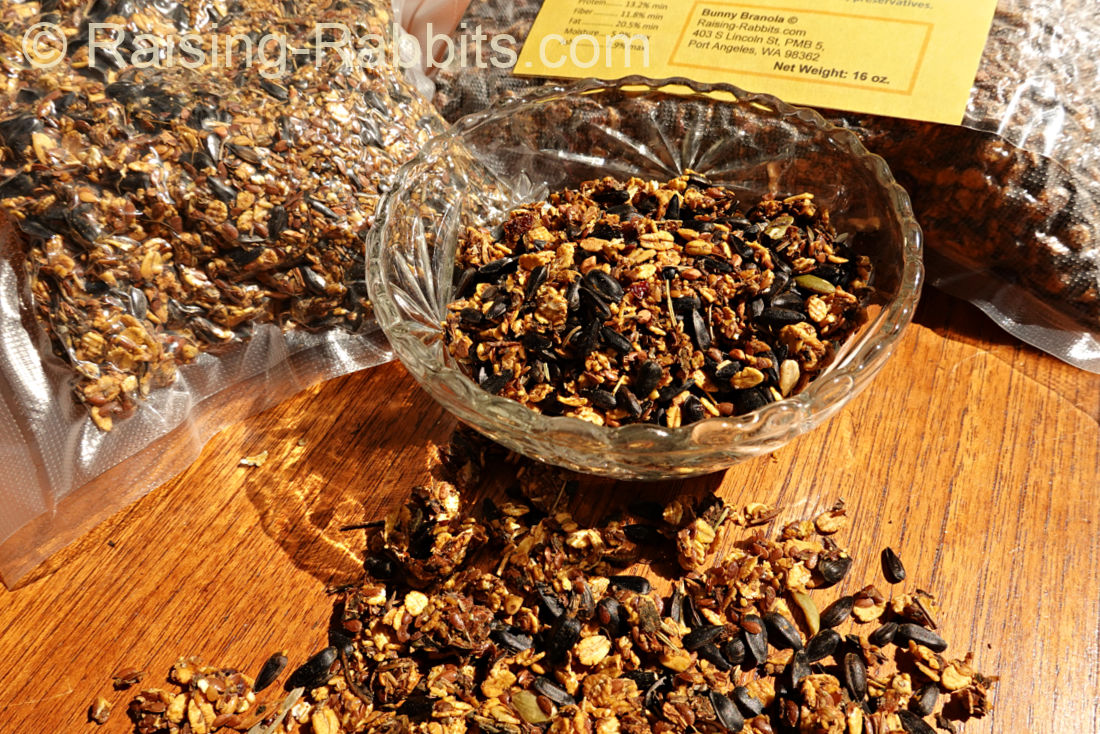
The Ultimate
Rabbit Nutritional Supplement and Treat!
4 delicious flavors! Sample packs available!
Yes! I want more info!
Yes, Buy Bunny Branola Now!
Look What's NEW!!
Our very own classy
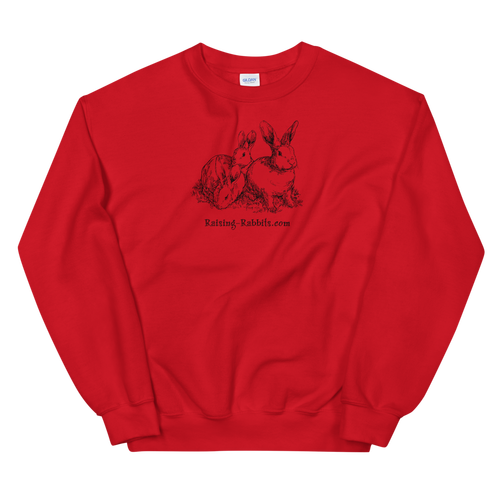
Raising Rabbits Sweatshirts, T-shirts, and Hoodies!
 |
 |
 |
.
We're now offering classy, unisex
Raising Rabbits
sweatshirts and hoodies,
Available in a great assortment of colors!
(We have unisex T-shirts too.)
Check out the Bunny Bazaar for our gorgeous
garments!
Order your own today!
They make great gifts too!!
Featured Rabbitries:
Click the Rabbitry Name Links:
Canada, Quebec
MapleRidge Stables Rabbitry
Himalayan Rabbits
Arizona
Hostile Hare
Chinchillas, Cages
Illinois
Open Doors Rabbitry
Lionheads, New Zealands
Kentucky
Goshen Bunnies
Holland Lop and Mini Plush Lop
New Jersey
Go Bunny Treats
All Natural Rabbit Treats
Mini Plush Lop Bunnies
All Natural Rabbit Treats
Belle's Bunny Boutique
Holland Lops & Mini Lion Lops
North Carolina
What The Fluffle Rabbitry
New Zealands, Champagnes
Breadbox Rabbitry
Netherland Dwarfs
The Farm at Fort Mill
Holland Lops
(Right across the South Carolina
border at Charlotte)
Pennsylvania
Happily Ever After
Mini Plush Lops, Holland Lops,
Netherland Dwarf, Lionhead,
Mini Plush Lop, & Mini Rex
Bunnies by Emma and Ellie
Holland Lop, Mini Lop,
Mini Plush Lop,
Mini Rex/Holland Lop Mix
Rhode Island
Shepherds Purse Rabbitry
Holland Lops
South Carolina
Jubilee Farms
Holland Lops
Washington
Cotton Candie Tails
Lionheads, Vienna-Marked
Subscribe to Rabbit Rhythms,
our e-newsletter !
Get rabbit news, husbandry and health tips mostly every month. It's easy - we only need your email address, then hit the 'subscribe' button. Enjoy!
Recent Articles


-
Raw Rabbit: Order raw frozen rabbit for pets
Mar 25, 24 07:45 PM
 Raw rabbit. Convenient online ordering of raw frozen rabbit as whole prey, partially processed, or ground, for feeding pets species-appropriate meals
 -
Farm at Fort Mill
Mar 01, 24 03:22 PM
 Farm at Fort Mill has moved. It is now Jubilee Farms Holland Lops, part of Edgemoor Equestrian, in Edgemoor SC. They offer riding lessons and host events.
 -
Jubilee Farms Holland Lops - Rabbitry in Edgemoor, SC
Feb 26, 24 04:01 PM
Jubilee Farms Holland Lops includes a Rabbitry in Edgemoor, SC. Jubilee Farms also has horses and riding lessons, and hosts events and learning camps.
Raising-Rabbits: Home of
The Rabbit Raising Problem Solver
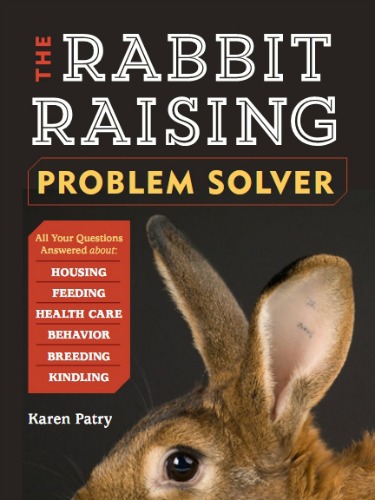
$22.62 - includes
- 10% off your autographed copy of Rabbit Raising Problem Solver
- All packaging, handling, and Media Mail postage costs (WA residents are subject to sales tax)
- Applies to US addresses - (sadly, Media Mail is not offered for international shipping, not even for really awesome books)
- (International shipping is available, of course, but it's out of our control how much they charge for shipping. Send us your country, city, and area code to obtain a shipping quote.)
* Affiliate Links*
As an affiliate of several companies, including Amazon.com, we earn from qualifying purchases. Your purchases from these affiliates come at no extra cost to you.

New! Comments
Have your say about what you just read! Leave me a comment in the box below.