Rabbit Pelts
"The Native American, First Nation, Indigenous People of America strive to be respectful of their environments. Many believe in thoughtfully honoring the lives of animals by only taking what is needed."
(National Museum of the American Indian, sponsored by the Smithsonian)
Don’t discard your rabbit pelts. Tan them, sew them, and wear them! This aligns with the tradition of respecting nature by taking only what is needed. When an animal is culled, every bit should be utilized, including the fur. By maximizing the resources that can be harvested and avoiding waste, you respect the animal and show good stewardship of God's creation.
Rex Rabbits
The pelts of any rabbit breed can be successfully tanned, however the rex rabbit is especially considered a ‘fur’ breed. Rex fur is short, plush and extremely dense. It looks and feels like a velvet carpet. The pictures on this page are all of rex pelts. We wish you could feel how dense and springy the fur is.
Preparing Your Rabbit Pelts for Tanning
- Cool the fresh skin by dropping it into a 5 gallon bucket of cold water, one by one, as you process your cull rabbits. They can remain submerged until you’re done with butchering.
- Thoroughly rinse all the blood out of the pelt. Any dried blood left in the pelt will stain the skin. This is no problem, unless you plan to make a garment worn with fur inside and skin outward, such as a winter cap.
- Squeeze the extra water out of the pelt (don’t twist or wring).
- Stretch the pelt on a wire pelt-stretcher. Or, you could tack it to a large piece of plywood, skin side outward, stretching it smooth without overstretching.
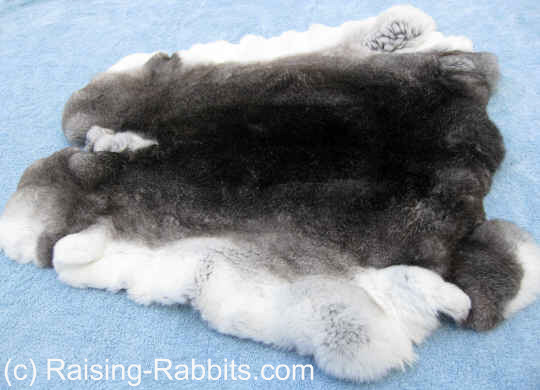
- Carefully scrape any meat and fat off the skin side of the pelt.
- Allow pelt to completely and thoroughly dry. Do not package the pelt until it is already completely dry.
- To store stretched and dried pelts, use moth crystals (paradichlorobenzene), not mothballs (naphthalene). Do not store in plastic.
- If you plan to tan the pelts yourself, you may freeze them after squeezing out the extra water, and accumulate several pelts to tan at once.
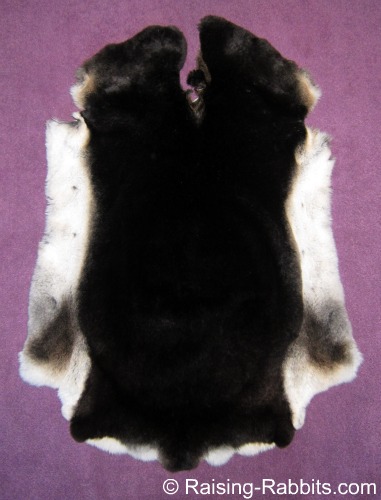
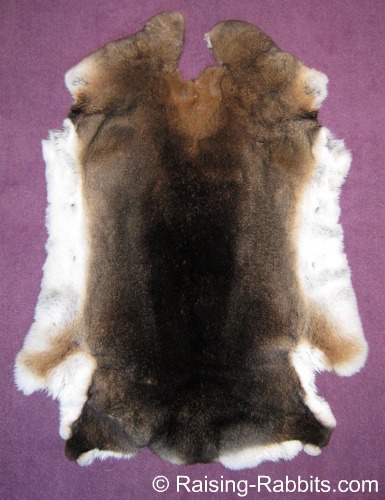
Want to have your rabbit pelts professionally tanned?
A Utah Rex rabbit farmer recommends Moyle’s Tannery, "The Official Tannery of the National Trappers Association." I'm told that Moyle's Tannery can make even a buck pelt soft and pliable.
The Process of Tanning Rabbit Pelts
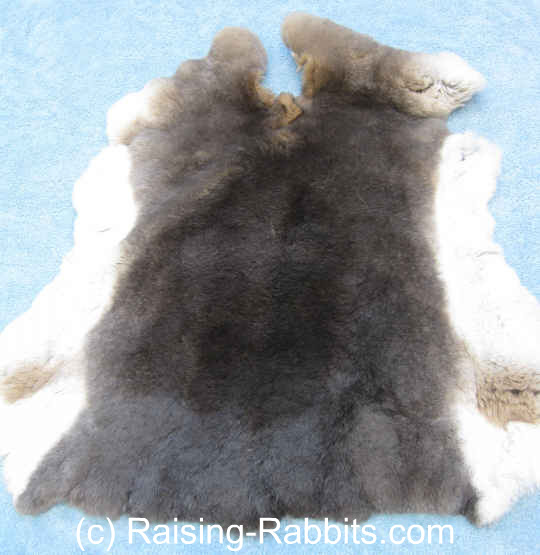 Opal Rex Pelt
Tanning requires up to several weeks of soaking in an alum or acid ‘brine,’ and then lots of elbow grease stretching and softening the pelt.
The finished result is almost magical -- a soft and supple, incredibly warm, material that can be sown into garments, hats, shoes, gloves, rugs, wall hangings, and bedspreads. Yurts and teepees are also traditionally made of animal skins, though not from rabbit ones.
In this fashion, animal skins have preserved human lives in northern climates for millennia.
Tanning Books
Tips from the experts, or at least from others with lots of tanning experience, is invaluable to any homesteader or backyard rabbit breeder. Here are two excellent resources:
Learn how to tan your rabbit (and cow, sheep, deer, etc) pelts at home. You'll find all sorts of tanning recipes, including tawing, smoking, curing with brains, and old-fashioned tanning with bark brine for many months (bark brine is used for making leather only).
These books will tell you what you need, where to get it, how to do it, and even patterns.
Tanning Recipes, Tanning Solutions, Other Instructions
The website, Mother Earth News, has several great articles on tanning, preserving, using, and crafting with rabbit hides. Here are a few selections, with lots more at the website:
How to Tan Rabbit Hides; By Kathy Kellogg, published on Jan 4, 2022, in the Mother Earth News.
Tanning Rabbit Hides: By Melissa Souza, published on Apr 21, 2017, in the Mother Earth News. "Step-by-step description of how I preserve rabbit hides using salt and alum."
How to Sew Rabbit Fur: By Kathy Kellogg, published on July 7, 2022, in the Mother Earth News.
How to Tan a Hide With Fur: By Anita Evangelista, published on Jan 4, 2022, in the Mother Earth News.
Another Option: Ready-mixed tanning solutions. One of the following bottles will tan an entire deer hide; it may last for 6 or more rabbit pelts. Bottles come with full instructions, and can be used with fur-on and fur-off:
Alum Crystals
1 pound alum equals 2 cups of alum, enough to tan 7-8 pelts, when using the Mother Earth tanning recipe as we do.
More Tools of the Trade
Wiebe Pelt Scraper:
The inner membrane of a pelt must be removed in order to correctly tan the hide. If using the Mother Earth alum recipe, you'll strip the membranes by hand during the soaking process. A pelt scraper helps remove any membrane material that proves difficult to pull free from the pelt.
If you dry the pelt on a stretcher, then the pelt scraper removes the fat and membrane before beginning the tanning process. The rabbit skin is thin; don't press too hard.
Skinning & Fur Handling Packages
I'm thinking these kits might be useful for bigger "game" than rabbits, but perhaps your skills run to hunting bigger game....
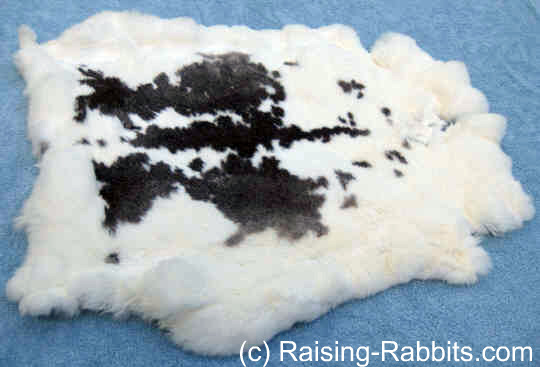 Spotted ('broken') Chinchilla Rex Pelt
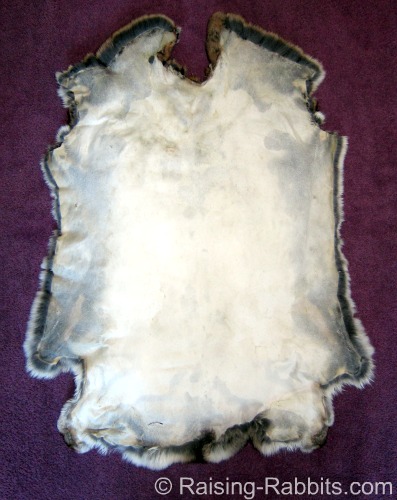 Underside of a Rex Pelt
This is the back side of a tanned castor rex rabbit pelt.
If it had been a fully primed pelt, it would be completely white. As it is, you can see the darkness in the pelt on the edges. This pelt was nearly prime over the back and down the sides, but not on the belly.
Even when freshly removed, the skin is white when prime and darkened when the coat is still growing in.
These Directions for a Rabbit Pelt Blanket require up to 50 pelts, cut into strips and sewn together - a Paiute Indian traditional method of staying warm in the winter. Fascinating!
Double-Value Guarantee
Our policy is to always OVER-deliver
on value,
which is why your purchase is fully covered by our
Double-Value
Guarantee.
Go ahead - take any of our e-books for a test drive. Peruse our detailed informational and educational e-books. Examine our plans for building rabbit cages, runs, or metal or PVC hutch frames. Check out the Rabbit Husbandry info e-books.
If you aren't completely satisfied that your e-book purchase is worth at least double, triple or even quadruple the price you paid, just drop us a note within 45 days, and we'll refund you the entire cost. That's our Double-Value Guarantee.
Note: When you purchase your
e-books, they will be in PDF format, so you can download them to any device that
supports PDF format. We advise making a back-up copy to a drive or cloud
account. If the books are lost, you can also purchase another copy from Raising-Rabbits.
* Affiliate Links*
As an affiliate of several companies, including Amazon.com, we earn from qualifying purchases. Your purchases from these affiliates come at no extra cost to you.
Bunny Bazaar!
Online Shopping Mall by Raising-Rabbits!
One-Stop Shop for Rabbit Swag for both Buns and Humans
Bunny Branola!
The Ultimate
Rabbit Nutritional Supplement and Treat!
4 delicious flavors! Sample packs available!
Yes! I want more info!
Yes, Buy Bunny Branola Now!
Look What's NEW!!
Our very own classy
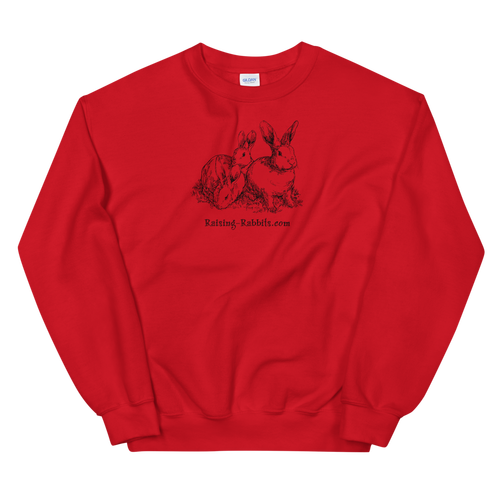
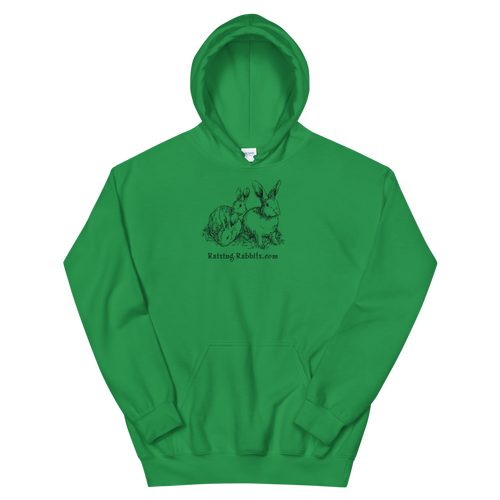
Raising Rabbits Sweatshirts, T-shirts, and Hoodies!
 |
 |
 |
.
We're now offering classy, unisex
Raising Rabbits
sweatshirts and hoodies,
Available in a great assortment of colors!
(We have unisex T-shirts too.)
Check out the Bunny Bazaar for our gorgeous
garments!
Order your own today!
They make great gifts too!!
Featured Rabbitries:
Click the Rabbitry Name Links:
Canada, Quebec
MapleRidge Stables Rabbitry
Himalayan Rabbits
Arizona
Hostile Hare
Chinchillas, Cages
Illinois
Open Doors Rabbitry
Lionheads, New Zealands
Kentucky
Goshen Bunnies
Holland Lop and Mini Plush Lop
New Jersey
Go Bunny Treats
All Natural Rabbit Treats
Mini Plush Lop Bunnies
All Natural Rabbit Treats
Belle's Bunny Boutique
Holland Lops & Mini Lion Lops
North Carolina
What The Fluffle Rabbitry
New Zealands, Champagnes
Breadbox Rabbitry
Netherland Dwarfs
The Farm at Fort Mill
Holland Lops
(Right across the South Carolina
border at Charlotte)
Pennsylvania
Happily Ever After
Mini Plush Lops, Holland Lops,
Netherland Dwarf, Lionhead,
Mini Plush Lop, & Mini Rex
Bunnies by Emma and Ellie
Holland Lop, Mini Lop,
Mini Plush Lop,
Mini Rex/Holland Lop Mix
Rhode Island
Shepherds Purse Rabbitry
Holland Lops
South Carolina
Jubilee Farms
Holland Lops
Washington
Cotton Candie Tails
Lionheads, Vienna-Marked
Subscribe to Rabbit Rhythms,
our e-newsletter !
Get rabbit news, husbandry and health tips mostly every month. It's easy - we only need your email address, then hit the 'subscribe' button. Enjoy!
Recent Articles


-
Raw Rabbit: Order raw frozen rabbit for pets
Mar 25, 24 07:45 PM
 Raw rabbit. Convenient online ordering of raw frozen rabbit as whole prey, partially processed, or ground, for feeding pets species-appropriate meals
 -
Farm at Fort Mill
Mar 01, 24 03:22 PM
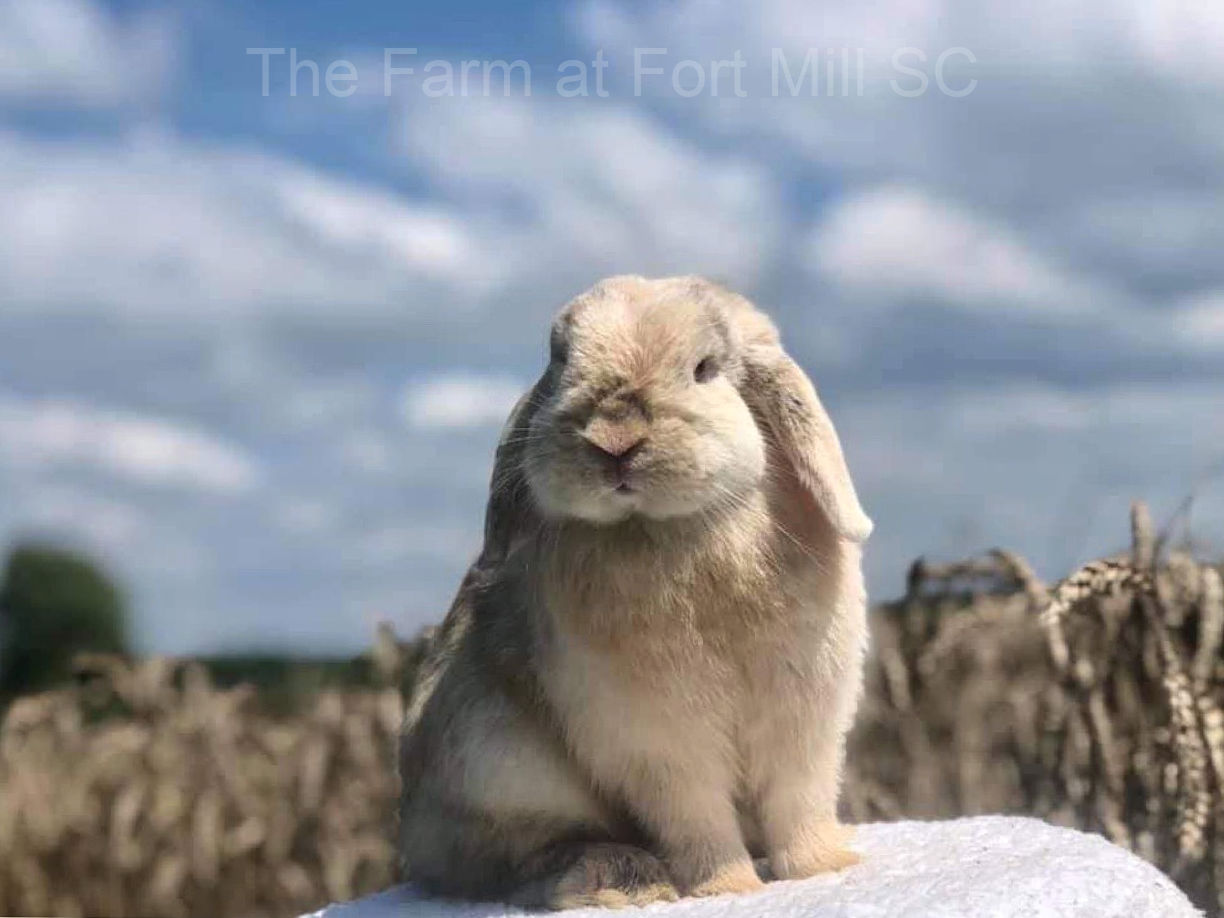 Farm at Fort Mill has moved. It is now Jubilee Farms Holland Lops, part of Edgemoor Equestrian, in Edgemoor SC. They offer riding lessons and host events.
 -
Jubilee Farms Holland Lops - Rabbitry in Edgemoor, SC
Feb 26, 24 04:01 PM
Jubilee Farms Holland Lops includes a Rabbitry in Edgemoor, SC. Jubilee Farms also has horses and riding lessons, and hosts events and learning camps.
Raising-Rabbits: Home of
The Rabbit Raising Problem Solver
$22.62 - includes
- 10% off your autographed copy of Rabbit Raising Problem Solver
- All packaging, handling, and Media Mail postage costs (WA residents are subject to sales tax)
- Applies to US addresses - (sadly, Media Mail is not offered for international shipping, not even for really awesome books)
- (International shipping is available, of course, but it's out of our control how much they charge for shipping. Send us your country, city, and area code to obtain a shipping quote.)
* Affiliate Links*
As an affiliate of several companies, including Amazon.com, we earn from qualifying purchases. Your purchases from these affiliates come at no extra cost to you.

New! Comments
Have your say about what you just read! Leave me a comment in the box below.