Epizootic Rabbit Enteropathy
Epizootic Rabbit Enteropathy (ERE) is a potentially lethal,
little understood but very dangerous threat to a rabbit’s health. It is a
fairly recent newcomer to American shores, though French rabbit farmers have
been losing rabbits to ERE since 1996.
ERE can look very much like enterotoxemia or mucoid enteritis in a rabbit. But the difference is in part its contagiousness. This severe digestive disease is 'epizootic,' meaning it often strikes many rabbits in a rabbitry at once. And when it does, it still might hop-scotch randomly, here or there. Some rabbits might remain symptom-free, while rabbits round about them fall ill and die.
At particular risk seem to be growing fryers or overweight rabbits.
What does epizootic
rabbit enteropathy look like?
The most consistent sign is rumbling sounds in the abdomen of a stricken rabbit within a day of exposure. The abdomen becomes very distended, and mucoid droppings are eventually seen under the cage. Within 4-6 days, rabbits with ERE will exhibit most of the following symptoms, however which symptoms might vary:
- Cecal impaction
- Watery Diarrhea
- Distended abdomen
- Mucus excretion (after 4th day)
- No fever
The illness peaks in 4-6 days, and can last 2 weeks or more. If the rabbit is going to die, it will likely die between day 3 and day 5. Typical losses are 20-50% of the herd. Rabbits begin to recover by day 7, and recovery occurs slowly.
If you were to perform a necropsy of the dead rabbits, you might find an impaction 20-30% of the time. You’d find a tremendous lot of gas and liquid ballooning the stomach. You’d also find considerable distention of the small intestine with liquid and a bit of gas.
What you won’t find are any outward signs of inflammation or other lesions. There may be mild microscopic changes in the lining of the small intestine, but these are not evident to the naked eye.
In the studies performed, up to 40% of infected rabbits
died, and 100% of study animals got sick. It didn’t seem to matter how much
exposure a rabbit received, whether small or large. All rabbits exposed became
equally sick and experienced the same mortality rates.
en
Rabbit Condition Enhancers: BOSS, Whole Oats (#ad)
In all these years, scientists have yet to identify the causative agent.
Nevertheless, this study strongly implicates bacteria as a cause and rules out viruses. But exactly which bacteria are the causative agents is still under discussion.
Scientists have identified rotavirus and Clostridium perfringens in all the 'inocula' taken from animals sick with ERE and used to infect the study rabbits. Researchers are still unsure of the role these germs play in the development of epizootic rabbit enteropathy without further study.
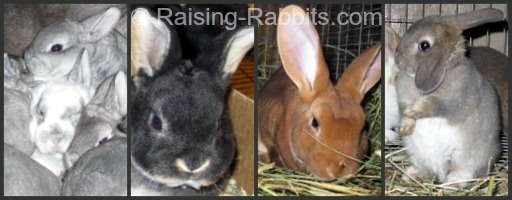 Thankfully these rabbits are completely healthy
Prevention and Treatment
Prevention:
- Always give hay to your rabbits!
Especially to your young bunnies. If your herd or house bunny gets sick, hay or
stemmy alfalfa doesn’t prevent or cure ERE, but it helps the infection work its
way out of the body, helps prevent a fatal intestinal impaction, and may reduce
fatalities.
- Don’t allow your adult rabbits to get fat. Limit
their daily ration, letting their weight be the guide
What to do if your rabbits get ERE:
- Stop all pellets and switch the herd to
hay ONLY, until the symptoms abate. This could take 2 weeks, possibly
- Get the help of a rabbit-savvy vet
asap
- The ‘usual’ antibiotics may not work, but in some
cases, rabbit breeders assert that the following drugs saved rabbit lives in
their barns:
- Neomycin Sulfate
- Panacur
- Metronidazole
for secondary clostridium infection (requires a vet prescription, BUT: check the comment titled "Metronidazole" below for a tip on obtaining without a prescription) - Disinfecting the barn with chlorhexadine at least once a week may help prevent the spread of the disease
Share your own story below. How did your rabbits fare, and how did you treat the outbreak of epizootic rabbit enteropathy in your rabbits?
Add your Comments or
Share your Experiences!
Your comments or experiences can help others who read them. So, comment away, and if you have pictures, you can post up to four of them. Pictures are always helpful.
(Have questions? Perhaps your question was already asked, and answered, below. If not, Karen has answered hundreds of your questions in her book: Rabbit Raising Problem Solver, covering every aspect of pet rabbit and livestock rabbit care as well as rabbit health and disease. We recommend it!)
Comments from Other Visitors...
Click below to see additional posts that other visitors have made to this page...
my experience with this was horrible 
I had 5 babies in one litter get this just days after weaning at 11 weeks from a doe who is believed to be a carrier. I lost 2 but 3 are alive 2 weeks …
Rabbits dying with ERE symptoms
I bought 7 does from a trusted friend, and for 2 weeks everything went good. Then one after another the new does starting dying then what they had spread …
Epizootic Rabbit Enteropathy Not rated yet
Please read this article if you are having problems with bloated (or dying) rabbits .
Epizootic Rabbit Enteropathy, or ERE for short, came to the …
After ERE, now what?? Not rated yet
After you have treated (for Epizootic Rabbit Enteropathy) and it seems you are clear, what then? I know you can seem to be clear and then it hits again, …
Metronidazole Not rated yet
You can get this WITHOUT a script if you go to the fish section of a pet store or online at KVvet.com It's under fish antibiotics and it comes in exactly …
Double-Value Guarantee
Our policy is to always OVER-deliver
on value,
which is why your purchase is fully covered by our
Double-Value
Guarantee.
Go ahead - take any of our e-books for a test drive. Peruse our detailed informational and educational e-books. Examine our plans for building rabbit cages, runs, or metal or PVC hutch frames. Check out the Rabbit Husbandry info e-books.
If you aren't completely satisfied that your e-book purchase is worth at least double, triple or even quadruple the price you paid, just drop us a note within 45 days, and we'll refund you the entire cost. That's our Double-Value Guarantee.
Note: When you purchase your
e-books, they will be in PDF format, so you can download them to any device that
supports PDF format. We advise making a back-up copy to a drive or cloud
account. If the books are lost, you can also purchase another copy from Raising-Rabbits.
* Affiliate Links*
As an affiliate of several companies, including Amazon.com, we earn from qualifying purchases. Your purchases from these affiliates come at no extra cost to you.
Bunny Bazaar!
Online Shopping Mall by Raising-Rabbits!
One-Stop Shop for Rabbit Swag for both Buns and Humans
Bunny Branola!
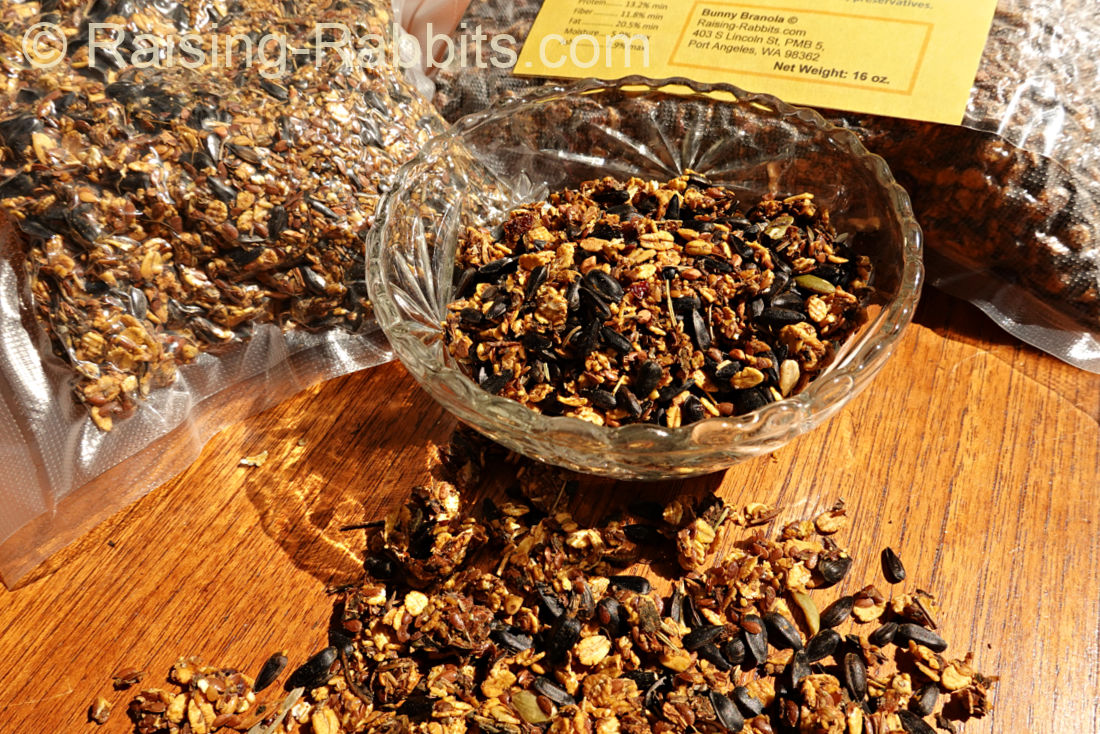
The Ultimate
Rabbit Nutritional Supplement and Treat!
4 delicious flavors! Sample packs available!
Yes! I want more info!
Yes, Buy Bunny Branola Now!
Look What's NEW!!
Our very own classy
Raising Rabbits Sweatshirts, T-shirts, and Hoodies!
 |
 |
 |
.
We're now offering classy, unisex
Raising Rabbits
sweatshirts and hoodies,
Available in a great assortment of colors!
(We have unisex T-shirts too.)
Check out the Bunny Bazaar for our gorgeous
garments!
Order your own today!
They make great gifts too!!
Featured Rabbitries:
Click the Rabbitry Name Links:
Canada, Quebec
MapleRidge Stables Rabbitry
Himalayan Rabbits
Arizona
Hostile Hare
Chinchillas, Cages
Illinois
Open Doors Rabbitry
Lionheads, New Zealands
Kentucky
Goshen Bunnies
Holland Lop and Mini Plush Lop
New Jersey
Go Bunny Treats
All Natural Rabbit Treats
Mini Plush Lop Bunnies
All Natural Rabbit Treats
Belle's Bunny Boutique
Holland Lops & Mini Lion Lops
North Carolina
What The Fluffle Rabbitry
New Zealands, Champagnes
Breadbox Rabbitry
Netherland Dwarfs
The Farm at Fort Mill
Holland Lops
(Right across the South Carolina
border at Charlotte)
Pennsylvania
Happily Ever After
Mini Plush Lops, Holland Lops,
Netherland Dwarf, Lionhead,
Mini Plush Lop, & Mini Rex
Bunnies by Emma and Ellie
Holland Lop, Mini Lop,
Mini Plush Lop,
Mini Rex/Holland Lop Mix
Rhode Island
Shepherds Purse Rabbitry
Holland Lops
South Carolina
Jubilee Farms
Holland Lops
Washington
Cotton Candie Tails
Lionheads, Vienna-Marked
Subscribe to Rabbit Rhythms,
our e-newsletter !
Get rabbit news, husbandry and health tips mostly every month. It's easy - we only need your email address, then hit the 'subscribe' button. Enjoy!
Recent Articles


-
Raw Rabbit: Order raw frozen rabbit for pets
Mar 25, 24 07:45 PM
 Raw rabbit. Convenient online ordering of raw frozen rabbit as whole prey, partially processed, or ground, for feeding pets species-appropriate meals
 -
Farm at Fort Mill
Mar 01, 24 03:22 PM
 Farm at Fort Mill has moved. It is now Jubilee Farms Holland Lops, part of Edgemoor Equestrian, in Edgemoor SC. They offer riding lessons and host events.
 -
Jubilee Farms Holland Lops - Rabbitry in Edgemoor, SC
Feb 26, 24 04:01 PM
Jubilee Farms Holland Lops includes a Rabbitry in Edgemoor, SC. Jubilee Farms also has horses and riding lessons, and hosts events and learning camps.
Raising-Rabbits: Home of
The Rabbit Raising Problem Solver
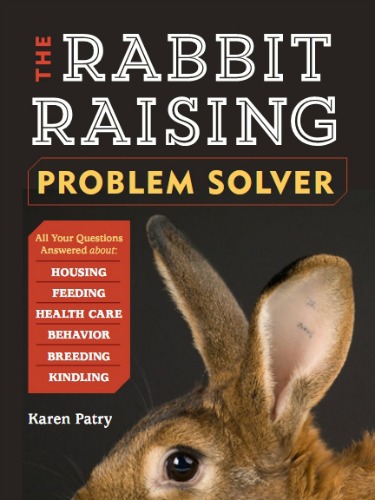
$22.62 - includes
- 10% off your autographed copy of Rabbit Raising Problem Solver
- All packaging, handling, and Media Mail postage costs (WA residents are subject to sales tax)
- Applies to US addresses - (sadly, Media Mail is not offered for international shipping, not even for really awesome books)
- (International shipping is available, of course, but it's out of our control how much they charge for shipping. Send us your country, city, and area code to obtain a shipping quote.)
* Affiliate Links*
As an affiliate of several companies, including Amazon.com, we earn from qualifying purchases. Your purchases from these affiliates come at no extra cost to you.

New! Comments
Have your say about what you just read! Leave me a comment in the box below.